
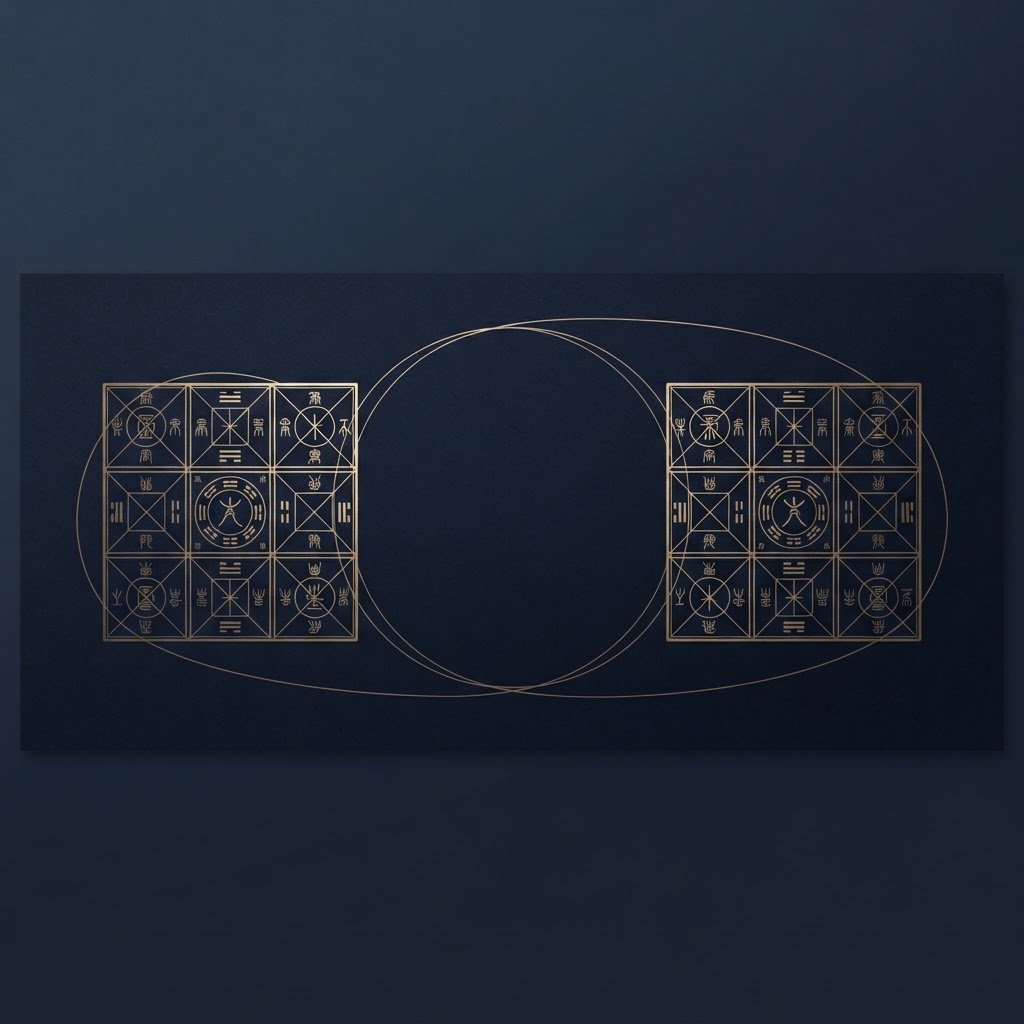
At 8:40 on a wet Tuesday morning, a client placed two printed charts beside one another and asked a deceptively simple question: why did the same answer seem to appear twice? The consultation concerned a lease renewal, not a battlefield. Yet the chart had a quality of repetition that made every proposed move feel like a return to the same doorway. That is the first useful encounter with a Fu Yin chart. It does not shout that nothing can happen. It shows that the conditions resist a quick change of position.
I teach Fu Yin as a reading of repeated arrangement. The heaven plate and earth plate return to matching positions, or the relevant layers mirror one another closely enough to produce a strong sense of sameness. The chart asks you to distinguish delay from refusal, caution from fear, and a genuine second attempt from an unconscious repetition of the first. If you want the larger map before continuing, begin with the Qi Men Dun Jia pillar guide, then return here with the nine palaces in mind.
Fu Yin is not a sentence imposed on the question. It is a warning that the next move may reproduce the conditions that created the question.
The repeated arrangement has a practical meaning
Students sometimes hear the name Fu Yin and imagine a supernatural lock. I use a more ordinary comparison. Think of a door that opens onto the same room each time you pull it. The door is functional. Your route is not changing. In a chart, the repetition belongs to the arrangement of signs, plates, doors, stars, deities, and palaces. The reading becomes useful when you ask which part is repeating and which part still has room to move.
That distinction prevents two common errors. The first is to reject every Fu Yin chart as bad. The second is to act as if repetition makes the outcome guaranteed. Neither position is careful enough. A stalled negotiation can still be repaired. A repeated medical appointment can still produce a diagnosis. A delayed move can still be the correct move later. The chart describes the quality of the moment, not a permanent identity attached to the people involved.
| Question | Weak reading | More useful reading |
|---|---|---|
| Why does the chart feel still? | Nothing will happen. | The present arrangement keeps reproducing itself. |
| Should the querent act? | Never act. | Change the preparation, timing, channel, or target first. |
| What does delay mean? | Failure is certain. | Conditions have not yet separated enough for a clean result. |
Read the chart before naming the delay
Start with the hour pillar and the question, not with a dramatic label. In a working consultation, I connect that observation to the actual facts: who can decide, what has been tried, what resource is available, and which part of the plan is still untested. This keeps the reading close to the question instead of allowing the label to take over.
Record the day stem, day branch, hour stem, hour branch, ju number, and whether the chart is Yin Dun or Yang Dun. In a working consultation, I connect that observation to the actual facts: who can decide, what has been tried, what resource is available, and which part of the plan is still untested. This keeps the reading close to the question instead of allowing the label to take over.
Mark the asker and the subject of the question before interpreting the repeated layers. In a working consultation, I connect that observation to the actual facts: who can decide, what has been tried, what resource is available, and which part of the plan is still untested. This keeps the reading close to the question instead of allowing the label to take over.
Start with the hour pillar and the question, not with a dramatic label. In a working consultation, I connect that observation to the actual facts: who can decide, what has been tried, what resource is available, and which part of the plan is still untested. This keeps the reading close to the question instead of allowing the label to take over.
Record the day stem, day branch, hour stem, hour branch, ju number, and whether the chart is Yin Dun or Yang Dun. In a working consultation, I connect that observation to the actual facts: who can decide, what has been tried, what resource is available, and which part of the plan is still untested. This keeps the reading close to the question instead of allowing the label to take over.
Mark the asker and the subject of the question before interpreting the repeated layers. In a working consultation, I connect that observation to the actual facts: who can decide, what has been tried, what resource is available, and which part of the plan is still untested. This keeps the reading close to the question instead of allowing the label to take over.
Start with the hour pillar and the question, not with a dramatic label. In a working consultation, I connect that observation to the actual facts: who can decide, what has been tried, what resource is available, and which part of the plan is still untested. This keeps the reading close to the question instead of allowing the label to take over.
Record the day stem, day branch, hour stem, hour branch, ju number, and whether the chart is Yin Dun or Yang Dun. In a working consultation, I connect that observation to the actual facts: who can decide, what has been tried, what resource is available, and which part of the plan is still untested. This keeps the reading close to the question instead of allowing the label to take over.
Mark the asker and the subject of the question before interpreting the repeated layers. In a working consultation, I connect that observation to the actual facts: who can decide, what has been tried, what resource is available, and which part of the plan is still untested. This keeps the reading close to the question instead of allowing the label to take over.
A mirror can preserve and restrict at once
A matching position can preserve a resource, a relationship, or a useful boundary. It can also preserve an outdated assumption. In a working consultation, I connect that observation to the actual facts: who can decide, what has been tried, what resource is available, and which part of the plan is still untested. This keeps the reading close to the question instead of allowing the label to take over.
The same door may protect a negotiation from rash speech while keeping the participants inside a circular exchange. In a working consultation, I connect that observation to the actual facts: who can decide, what has been tried, what resource is available, and which part of the plan is still untested. This keeps the reading close to the question instead of allowing the label to take over.
The same star can describe a skill that remains available, but not yet deployed in a new setting. In a working consultation, I connect that observation to the actual facts: who can decide, what has been tried, what resource is available, and which part of the plan is still untested. This keeps the reading close to the question instead of allowing the label to take over.
A matching position can preserve a resource, a relationship, or a useful boundary. It can also preserve an outdated assumption. In a working consultation, I connect that observation to the actual facts: who can decide, what has been tried, what resource is available, and which part of the plan is still untested. This keeps the reading close to the question instead of allowing the label to take over.
The same door may protect a negotiation from rash speech while keeping the participants inside a circular exchange. In a working consultation, I connect that observation to the actual facts: who can decide, what has been tried, what resource is available, and which part of the plan is still untested. This keeps the reading close to the question instead of allowing the label to take over.
The same star can describe a skill that remains available, but not yet deployed in a new setting. In a working consultation, I connect that observation to the actual facts: who can decide, what has been tried, what resource is available, and which part of the plan is still untested. This keeps the reading close to the question instead of allowing the label to take over.
A matching position can preserve a resource, a relationship, or a useful boundary. It can also preserve an outdated assumption. In a working consultation, I connect that observation to the actual facts: who can decide, what has been tried, what resource is available, and which part of the plan is still untested. This keeps the reading close to the question instead of allowing the label to take over.
The same door may protect a negotiation from rash speech while keeping the participants inside a circular exchange. In a working consultation, I connect that observation to the actual facts: who can decide, what has been tried, what resource is available, and which part of the plan is still untested. This keeps the reading close to the question instead of allowing the label to take over.
The same star can describe a skill that remains available, but not yet deployed in a new setting. In a working consultation, I connect that observation to the actual facts: who can decide, what has been tried, what resource is available, and which part of the plan is still untested. This keeps the reading close to the question instead of allowing the label to take over.
What still moves inside a still chart
Movement may occur in the calendar even when the chart repeats its arrangement. In a working consultation, I connect that observation to the actual facts: who can decide, what has been tried, what resource is available, and which part of the plan is still untested. This keeps the reading close to the question instead of allowing the label to take over.
People can gather evidence, repair a document, change a budget, or obtain consent before the outer decision. In a working consultation, I connect that observation to the actual facts: who can decide, what has been tried, what resource is available, and which part of the plan is still untested. This keeps the reading close to the question instead of allowing the label to take over.
A small internal adjustment often matters more than a dramatic public gesture. In a working consultation, I connect that observation to the actual facts: who can decide, what has been tried, what resource is available, and which part of the plan is still untested. This keeps the reading close to the question instead of allowing the label to take over.
Movement may occur in the calendar even when the chart repeats its arrangement. In a working consultation, I connect that observation to the actual facts: who can decide, what has been tried, what resource is available, and which part of the plan is still untested. This keeps the reading close to the question instead of allowing the label to take over.
People can gather evidence, repair a document, change a budget, or obtain consent before the outer decision. In a working consultation, I connect that observation to the actual facts: who can decide, what has been tried, what resource is available, and which part of the plan is still untested. This keeps the reading close to the question instead of allowing the label to take over.
A small internal adjustment often matters more than a dramatic public gesture. In a working consultation, I connect that observation to the actual facts: who can decide, what has been tried, what resource is available, and which part of the plan is still untested. This keeps the reading close to the question instead of allowing the label to take over.
Movement may occur in the calendar even when the chart repeats its arrangement. In a working consultation, I connect that observation to the actual facts: who can decide, what has been tried, what resource is available, and which part of the plan is still untested. This keeps the reading close to the question instead of allowing the label to take over.
People can gather evidence, repair a document, change a budget, or obtain consent before the outer decision. In a working consultation, I connect that observation to the actual facts: who can decide, what has been tried, what resource is available, and which part of the plan is still untested. This keeps the reading close to the question instead of allowing the label to take over.
A small internal adjustment often matters more than a dramatic public gesture. In a working consultation, I connect that observation to the actual facts: who can decide, what has been tried, what resource is available, and which part of the plan is still untested. This keeps the reading close to the question instead of allowing the label to take over.
The question must be made narrower
Fu Yin becomes easier to read when the question has one subject, one time horizon, and one decision. In a working consultation, I connect that observation to the actual facts: who can decide, what has been tried, what resource is available, and which part of the plan is still untested. This keeps the reading close to the question instead of allowing the label to take over.
Do not ask whether an entire company will succeed if the immediate issue is a lease clause. In a working consultation, I connect that observation to the actual facts: who can decide, what has been tried, what resource is available, and which part of the plan is still untested. This keeps the reading close to the question instead of allowing the label to take over.
A narrow question reveals whether the repetition belongs to the action, the other party, the location, or the timing. In a working consultation, I connect that observation to the actual facts: who can decide, what has been tried, what resource is available, and which part of the plan is still untested. This keeps the reading close to the question instead of allowing the label to take over.
Fu Yin becomes easier to read when the question has one subject, one time horizon, and one decision. In a working consultation, I connect that observation to the actual facts: who can decide, what has been tried, what resource is available, and which part of the plan is still untested. This keeps the reading close to the question instead of allowing the label to take over.
Do not ask whether an entire company will succeed if the immediate issue is a lease clause. In a working consultation, I connect that observation to the actual facts: who can decide, what has been tried, what resource is available, and which part of the plan is still untested. This keeps the reading close to the question instead of allowing the label to take over.
A narrow question reveals whether the repetition belongs to the action, the other party, the location, or the timing. In a working consultation, I connect that observation to the actual facts: who can decide, what has been tried, what resource is available, and which part of the plan is still untested. This keeps the reading close to the question instead of allowing the label to take over.
Fu Yin becomes easier to read when the question has one subject, one time horizon, and one decision. In a working consultation, I connect that observation to the actual facts: who can decide, what has been tried, what resource is available, and which part of the plan is still untested. This keeps the reading close to the question instead of allowing the label to take over.
Do not ask whether an entire company will succeed if the immediate issue is a lease clause. In a working consultation, I connect that observation to the actual facts: who can decide, what has been tried, what resource is available, and which part of the plan is still untested. This keeps the reading close to the question instead of allowing the label to take over.
A narrow question reveals whether the repetition belongs to the action, the other party, the location, or the timing. In a working consultation, I connect that observation to the actual facts: who can decide, what has been tried, what resource is available, and which part of the plan is still untested. This keeps the reading close to the question instead of allowing the label to take over.
Door behavior under repeated conditions
A Rest Door may favor recovery and review rather than a launch. In a working consultation, I connect that observation to the actual facts: who can decide, what has been tried, what resource is available, and which part of the plan is still untested. This keeps the reading close to the question instead of allowing the label to take over.
An Open Door may keep access available while requiring a better proposal. In a working consultation, I connect that observation to the actual facts: who can decide, what has been tried, what resource is available, and which part of the plan is still untested. This keeps the reading close to the question instead of allowing the label to take over.
A Dispute Door can show that the same argument will return unless the terms of engagement change. In a working consultation, I connect that observation to the actual facts: who can decide, what has been tried, what resource is available, and which part of the plan is still untested. This keeps the reading close to the question instead of allowing the label to take over.
A Rest Door may favor recovery and review rather than a launch. In a working consultation, I connect that observation to the actual facts: who can decide, what has been tried, what resource is available, and which part of the plan is still untested. This keeps the reading close to the question instead of allowing the label to take over.
An Open Door may keep access available while requiring a better proposal. In a working consultation, I connect that observation to the actual facts: who can decide, what has been tried, what resource is available, and which part of the plan is still untested. This keeps the reading close to the question instead of allowing the label to take over.
A Dispute Door can show that the same argument will return unless the terms of engagement change. In a working consultation, I connect that observation to the actual facts: who can decide, what has been tried, what resource is available, and which part of the plan is still untested. This keeps the reading close to the question instead of allowing the label to take over.
A Rest Door may favor recovery and review rather than a launch. In a working consultation, I connect that observation to the actual facts: who can decide, what has been tried, what resource is available, and which part of the plan is still untested. This keeps the reading close to the question instead of allowing the label to take over.
An Open Door may keep access available while requiring a better proposal. In a working consultation, I connect that observation to the actual facts: who can decide, what has been tried, what resource is available, and which part of the plan is still untested. This keeps the reading close to the question instead of allowing the label to take over.
A Dispute Door can show that the same argument will return unless the terms of engagement change. In a working consultation, I connect that observation to the actual facts: who can decide, what has been tried, what resource is available, and which part of the plan is still untested. This keeps the reading close to the question instead of allowing the label to take over.
Stars add temperament to the pause
The Problem Star can point to a recurring fault that needs diagnosis before expansion. In a working consultation, I connect that observation to the actual facts: who can decide, what has been tried, what resource is available, and which part of the plan is still untested. This keeps the reading close to the question instead of allowing the label to take over.
The Impulse Star may tempt a fast move that simply recreates the original mistake. In a working consultation, I connect that observation to the actual facts: who can decide, what has been tried, what resource is available, and which part of the plan is still untested. This keeps the reading close to the question instead of allowing the label to take over.
The Advisor Star can reward consultation, training, and a second review by someone competent. In a working consultation, I connect that observation to the actual facts: who can decide, what has been tried, what resource is available, and which part of the plan is still untested. This keeps the reading close to the question instead of allowing the label to take over.
The Problem Star can point to a recurring fault that needs diagnosis before expansion. In a working consultation, I connect that observation to the actual facts: who can decide, what has been tried, what resource is available, and which part of the plan is still untested. This keeps the reading close to the question instead of allowing the label to take over.
The Impulse Star may tempt a fast move that simply recreates the original mistake. In a working consultation, I connect that observation to the actual facts: who can decide, what has been tried, what resource is available, and which part of the plan is still untested. This keeps the reading close to the question instead of allowing the label to take over.
The Advisor Star can reward consultation, training, and a second review by someone competent. In a working consultation, I connect that observation to the actual facts: who can decide, what has been tried, what resource is available, and which part of the plan is still untested. This keeps the reading close to the question instead of allowing the label to take over.
The Problem Star can point to a recurring fault that needs diagnosis before expansion. In a working consultation, I connect that observation to the actual facts: who can decide, what has been tried, what resource is available, and which part of the plan is still untested. This keeps the reading close to the question instead of allowing the label to take over.
The Impulse Star may tempt a fast move that simply recreates the original mistake. In a working consultation, I connect that observation to the actual facts: who can decide, what has been tried, what resource is available, and which part of the plan is still untested. This keeps the reading close to the question instead of allowing the label to take over.
The Advisor Star can reward consultation, training, and a second review by someone competent. In a working consultation, I connect that observation to the actual facts: who can decide, what has been tried, what resource is available, and which part of the plan is still untested. This keeps the reading close to the question instead of allowing the label to take over.
Deities describe the social atmosphere
The Partner presence can keep an alliance intact, but it may also preserve an old arrangement. In a working consultation, I connect that observation to the actual facts: who can decide, what has been tried, what resource is available, and which part of the plan is still untested. This keeps the reading close to the question instead of allowing the label to take over.
The Serpent can make the repeated path feel more complicated than it is, especially when anxiety fills gaps in the evidence. In a working consultation, I connect that observation to the actual facts: who can decide, what has been tried, what resource is available, and which part of the plan is still untested. This keeps the reading close to the question instead of allowing the label to take over.
The Nine Earth quality favors holding ground, storing resources, and waiting for a stable base. In a working consultation, I connect that observation to the actual facts: who can decide, what has been tried, what resource is available, and which part of the plan is still untested. This keeps the reading close to the question instead of allowing the label to take over.
The Partner presence can keep an alliance intact, but it may also preserve an old arrangement. In a working consultation, I connect that observation to the actual facts: who can decide, what has been tried, what resource is available, and which part of the plan is still untested. This keeps the reading close to the question instead of allowing the label to take over.
The Serpent can make the repeated path feel more complicated than it is, especially when anxiety fills gaps in the evidence. In a working consultation, I connect that observation to the actual facts: who can decide, what has been tried, what resource is available, and which part of the plan is still untested. This keeps the reading close to the question instead of allowing the label to take over.
The Nine Earth quality favors holding ground, storing resources, and waiting for a stable base. In a working consultation, I connect that observation to the actual facts: who can decide, what has been tried, what resource is available, and which part of the plan is still untested. This keeps the reading close to the question instead of allowing the label to take over.
The Partner presence can keep an alliance intact, but it may also preserve an old arrangement. In a working consultation, I connect that observation to the actual facts: who can decide, what has been tried, what resource is available, and which part of the plan is still untested. This keeps the reading close to the question instead of allowing the label to take over.
The Serpent can make the repeated path feel more complicated than it is, especially when anxiety fills gaps in the evidence. In a working consultation, I connect that observation to the actual facts: who can decide, what has been tried, what resource is available, and which part of the plan is still untested. This keeps the reading close to the question instead of allowing the label to take over.
The Nine Earth quality favors holding ground, storing resources, and waiting for a stable base. In a working consultation, I connect that observation to the actual facts: who can decide, what has been tried, what resource is available, and which part of the plan is still untested. This keeps the reading close to the question instead of allowing the label to take over.
Palace context prevents empty symbolism
North can bring the matter toward rest, roots, and quiet timing. In a working consultation, I connect that observation to the actual facts: who can decide, what has been tried, what resource is available, and which part of the plan is still untested. This keeps the reading close to the question instead of allowing the label to take over.
East may show a beginning that needs a better sequence rather than a louder announcement. In a working consultation, I connect that observation to the actual facts: who can decide, what has been tried, what resource is available, and which part of the plan is still untested. This keeps the reading close to the question instead of allowing the label to take over.
South can make visibility repeat until the presentation becomes precise enough to be trusted. In a working consultation, I connect that observation to the actual facts: who can decide, what has been tried, what resource is available, and which part of the plan is still untested. This keeps the reading close to the question instead of allowing the label to take over.
North can bring the matter toward rest, roots, and quiet timing. In a working consultation, I connect that observation to the actual facts: who can decide, what has been tried, what resource is available, and which part of the plan is still untested. This keeps the reading close to the question instead of allowing the label to take over.
East may show a beginning that needs a better sequence rather than a louder announcement. In a working consultation, I connect that observation to the actual facts: who can decide, what has been tried, what resource is available, and which part of the plan is still untested. This keeps the reading close to the question instead of allowing the label to take over.
South can make visibility repeat until the presentation becomes precise enough to be trusted. In a working consultation, I connect that observation to the actual facts: who can decide, what has been tried, what resource is available, and which part of the plan is still untested. This keeps the reading close to the question instead of allowing the label to take over.
North can bring the matter toward rest, roots, and quiet timing. In a working consultation, I connect that observation to the actual facts: who can decide, what has been tried, what resource is available, and which part of the plan is still untested. This keeps the reading close to the question instead of allowing the label to take over.
East may show a beginning that needs a better sequence rather than a louder announcement. In a working consultation, I connect that observation to the actual facts: who can decide, what has been tried, what resource is available, and which part of the plan is still untested. This keeps the reading close to the question instead of allowing the label to take over.
South can make visibility repeat until the presentation becomes precise enough to be trusted. In a working consultation, I connect that observation to the actual facts: who can decide, what has been tried, what resource is available, and which part of the plan is still untested. This keeps the reading close to the question instead of allowing the label to take over.
A delayed answer is still an answer
The chart may answer a timing question by showing that the proposed window is too similar to the previous one. In a working consultation, I connect that observation to the actual facts: who can decide, what has been tried, what resource is available, and which part of the plan is still untested. This keeps the reading close to the question instead of allowing the label to take over.
A delay can be constructive when it produces a new document, a different counterpart, or a more realistic scope. In a working consultation, I connect that observation to the actual facts: who can decide, what has been tried, what resource is available, and which part of the plan is still untested. This keeps the reading close to the question instead of allowing the label to take over.
The reader should state exactly what changed before calling a second attempt successful. In a working consultation, I connect that observation to the actual facts: who can decide, what has been tried, what resource is available, and which part of the plan is still untested. This keeps the reading close to the question instead of allowing the label to take over.
The chart may answer a timing question by showing that the proposed window is too similar to the previous one. In a working consultation, I connect that observation to the actual facts: who can decide, what has been tried, what resource is available, and which part of the plan is still untested. This keeps the reading close to the question instead of allowing the label to take over.
A delay can be constructive when it produces a new document, a different counterpart, or a more realistic scope. In a working consultation, I connect that observation to the actual facts: who can decide, what has been tried, what resource is available, and which part of the plan is still untested. This keeps the reading close to the question instead of allowing the label to take over.
The reader should state exactly what changed before calling a second attempt successful. In a working consultation, I connect that observation to the actual facts: who can decide, what has been tried, what resource is available, and which part of the plan is still untested. This keeps the reading close to the question instead of allowing the label to take over.
The chart may answer a timing question by showing that the proposed window is too similar to the previous one. In a working consultation, I connect that observation to the actual facts: who can decide, what has been tried, what resource is available, and which part of the plan is still untested. This keeps the reading close to the question instead of allowing the label to take over.
A delay can be constructive when it produces a new document, a different counterpart, or a more realistic scope. In a working consultation, I connect that observation to the actual facts: who can decide, what has been tried, what resource is available, and which part of the plan is still untested. This keeps the reading close to the question instead of allowing the label to take over.
The reader should state exactly what changed before calling a second attempt successful. In a working consultation, I connect that observation to the actual facts: who can decide, what has been tried, what resource is available, and which part of the plan is still untested. This keeps the reading close to the question instead of allowing the label to take over.
Use the chart as a testable instruction
Choose one assumption and write the evidence that would change it. In a working consultation, I connect that observation to the actual facts: who can decide, what has been tried, what resource is available, and which part of the plan is still untested. This keeps the reading close to the question instead of allowing the label to take over.
Set a review date rather than leaving delay open-ended. In a working consultation, I connect that observation to the actual facts: who can decide, what has been tried, what resource is available, and which part of the plan is still untested. This keeps the reading close to the question instead of allowing the label to take over.
Name the smallest action that creates a new condition without forcing the final result. In a working consultation, I connect that observation to the actual facts: who can decide, what has been tried, what resource is available, and which part of the plan is still untested. This keeps the reading close to the question instead of allowing the label to take over.
Choose one assumption and write the evidence that would change it. In a working consultation, I connect that observation to the actual facts: who can decide, what has been tried, what resource is available, and which part of the plan is still untested. This keeps the reading close to the question instead of allowing the label to take over.
Set a review date rather than leaving delay open-ended. In a working consultation, I connect that observation to the actual facts: who can decide, what has been tried, what resource is available, and which part of the plan is still untested. This keeps the reading close to the question instead of allowing the label to take over.
Name the smallest action that creates a new condition without forcing the final result. In a working consultation, I connect that observation to the actual facts: who can decide, what has been tried, what resource is available, and which part of the plan is still untested. This keeps the reading close to the question instead of allowing the label to take over.
Choose one assumption and write the evidence that would change it. In a working consultation, I connect that observation to the actual facts: who can decide, what has been tried, what resource is available, and which part of the plan is still untested. This keeps the reading close to the question instead of allowing the label to take over.
Set a review date rather than leaving delay open-ended. In a working consultation, I connect that observation to the actual facts: who can decide, what has been tried, what resource is available, and which part of the plan is still untested. This keeps the reading close to the question instead of allowing the label to take over.
Name the smallest action that creates a new condition without forcing the final result. In a working consultation, I connect that observation to the actual facts: who can decide, what has been tried, what resource is available, and which part of the plan is still untested. This keeps the reading close to the question instead of allowing the label to take over.
A desk method for identifying the loop
Pass 1: name the unchanged condition
Write one sentence beginning with “The condition that has not changed is”. For case 1, the sentence might identify the same decision maker, the same document, the same room, the same budget ceiling, or the same emotional assumption. Do not write “bad energy” as a substitute for a fact. Fu Yin becomes practical only after the repeated condition has a name that another person can verify.
Pass 2: name the unchanged condition
Write one sentence beginning with “The condition that has not changed is”. For case 2, the sentence might identify the same decision maker, the same document, the same room, the same budget ceiling, or the same emotional assumption. Do not write “bad energy” as a substitute for a fact. Fu Yin becomes practical only after the repeated condition has a name that another person can verify.
Pass 3: name the unchanged condition
Write one sentence beginning with “The condition that has not changed is”. For case 3, the sentence might identify the same decision maker, the same document, the same room, the same budget ceiling, or the same emotional assumption. Do not write “bad energy” as a substitute for a fact. Fu Yin becomes practical only after the repeated condition has a name that another person can verify.
Pass 4: name the unchanged condition
Write one sentence beginning with “The condition that has not changed is”. For case 4, the sentence might identify the same decision maker, the same document, the same room, the same budget ceiling, or the same emotional assumption. Do not write “bad energy” as a substitute for a fact. Fu Yin becomes practical only after the repeated condition has a name that another person can verify.
Pass 5: name the unchanged condition
Write one sentence beginning with “The condition that has not changed is”. For case 5, the sentence might identify the same decision maker, the same document, the same room, the same budget ceiling, or the same emotional assumption. Do not write “bad energy” as a substitute for a fact. Fu Yin becomes practical only after the repeated condition has a name that another person can verify.
Pass 6: name the unchanged condition
Write one sentence beginning with “The condition that has not changed is”. For case 6, the sentence might identify the same decision maker, the same document, the same room, the same budget ceiling, or the same emotional assumption. Do not write “bad energy” as a substitute for a fact. Fu Yin becomes practical only after the repeated condition has a name that another person can verify.
Pass 7: name the unchanged condition
Write one sentence beginning with “The condition that has not changed is”. For case 7, the sentence might identify the same decision maker, the same document, the same room, the same budget ceiling, or the same emotional assumption. Do not write “bad energy” as a substitute for a fact. Fu Yin becomes practical only after the repeated condition has a name that another person can verify.
Pass 8: name the unchanged condition
Write one sentence beginning with “The condition that has not changed is”. For case 8, the sentence might identify the same decision maker, the same document, the same room, the same budget ceiling, or the same emotional assumption. Do not write “bad energy” as a substitute for a fact. Fu Yin becomes practical only after the repeated condition has a name that another person can verify.
Pass 9: name the unchanged condition
Write one sentence beginning with “The condition that has not changed is”. For case 9, the sentence might identify the same decision maker, the same document, the same room, the same budget ceiling, or the same emotional assumption. Do not write “bad energy” as a substitute for a fact. Fu Yin becomes practical only after the repeated condition has a name that another person can verify.
Pass 10: name the unchanged condition
Write one sentence beginning with “The condition that has not changed is”. For case 10, the sentence might identify the same decision maker, the same document, the same room, the same budget ceiling, or the same emotional assumption. Do not write “bad energy” as a substitute for a fact. Fu Yin becomes practical only after the repeated condition has a name that another person can verify.
Pass 11: name the unchanged condition
Write one sentence beginning with “The condition that has not changed is”. For case 11, the sentence might identify the same decision maker, the same document, the same room, the same budget ceiling, or the same emotional assumption. Do not write “bad energy” as a substitute for a fact. Fu Yin becomes practical only after the repeated condition has a name that another person can verify.
Pass 12: name the unchanged condition
Write one sentence beginning with “The condition that has not changed is”. For case 12, the sentence might identify the same decision maker, the same document, the same room, the same budget ceiling, or the same emotional assumption. Do not write “bad energy” as a substitute for a fact. Fu Yin becomes practical only after the repeated condition has a name that another person can verify.
Pass 13: name the unchanged condition
Write one sentence beginning with “The condition that has not changed is”. For case 13, the sentence might identify the same decision maker, the same document, the same room, the same budget ceiling, or the same emotional assumption. Do not write “bad energy” as a substitute for a fact. Fu Yin becomes practical only after the repeated condition has a name that another person can verify.
Pass 14: name the unchanged condition
Write one sentence beginning with “The condition that has not changed is”. For case 14, the sentence might identify the same decision maker, the same document, the same room, the same budget ceiling, or the same emotional assumption. Do not write “bad energy” as a substitute for a fact. Fu Yin becomes practical only after the repeated condition has a name that another person can verify.
Pass 15: name the unchanged condition
Write one sentence beginning with “The condition that has not changed is”. For case 15, the sentence might identify the same decision maker, the same document, the same room, the same budget ceiling, or the same emotional assumption. Do not write “bad energy” as a substitute for a fact. Fu Yin becomes practical only after the repeated condition has a name that another person can verify.
Pass 16: name the unchanged condition
Write one sentence beginning with “The condition that has not changed is”. For case 16, the sentence might identify the same decision maker, the same document, the same room, the same budget ceiling, or the same emotional assumption. Do not write “bad energy” as a substitute for a fact. Fu Yin becomes practical only after the repeated condition has a name that another person can verify.
Pass 17: name the unchanged condition
Write one sentence beginning with “The condition that has not changed is”. For case 17, the sentence might identify the same decision maker, the same document, the same room, the same budget ceiling, or the same emotional assumption. Do not write “bad energy” as a substitute for a fact. Fu Yin becomes practical only after the repeated condition has a name that another person can verify.
Pass 18: name the unchanged condition
Write one sentence beginning with “The condition that has not changed is”. For case 18, the sentence might identify the same decision maker, the same document, the same room, the same budget ceiling, or the same emotional assumption. Do not write “bad energy” as a substitute for a fact. Fu Yin becomes practical only after the repeated condition has a name that another person can verify.
| Layer | What to compare | Useful follow-up |
|---|---|---|
| Heaven | External timing and visible movement | What has changed outside the querent? |
| Earth | Place, resources, and current footing | What remains physically fixed? |
| Human arrangement | Choice, conduct, and relationship | Who is repeating the old response? |
| Door, star, deity | Mode, temperament, and social tone | What quality should be adjusted? |
The remedy for repetition is not always speed. Sometimes it is a new input, a new witness, or a new question.
Three cases where waiting changes the result
The lease renewal
A restaurant owner wanted a signature before the end of a Friday. The chart repeated the existing arrangement. The useful instruction was to request the missing maintenance schedule, not to threaten departure. Five days later, the negotiation contained a new fact and no longer asked the same question. I would not claim that the chart caused the later result. The value was diagnostic. It helped the people notice that their process had not changed, then choose a controlled change that could be observed.
For a student, the lesson is simple: state the intervention before stating the prediction. If you cannot say what will be different next time, you are probably describing the same loop in new words.
The delayed hiring decision
A manager had interviewed the same candidate twice and received the same vague reference. The repeated chart supported another review only if a specific work sample was added. The delay became productive because the evidence changed. I would not claim that the chart caused the later result. The value was diagnostic. It helped the people notice that their process had not changed, then choose a controlled change that could be observed.
For a student, the lesson is simple: state the intervention before stating the prediction. If you cannot say what will be different next time, you are probably describing the same loop in new words.
The family relocation
A couple kept comparing the same two neighborhoods using an unchanged budget. The chart did not choose a magical address. It showed that repeating the comparison would repeat the anxiety. They changed the commuting requirement, then assessed the options again. I would not claim that the chart caused the later result. The value was diagnostic. It helped the people notice that their process had not changed, then choose a controlled change that could be observed.
For a student, the lesson is simple: state the intervention before stating the prediction. If you cannot say what will be different next time, you are probably describing the same loop in new words.
Fu Yin and the other timing signals
Fu Yin should be read alongside the ju, the question, and the chart’s full structure. A favorable door does not erase repetition. A difficult star does not prove that waiting is useless. The 1080 ju cycle supplies the time architecture, while the local arrangement shows how the present question sits inside it. Students who want the calendar foundation can compare this article with the 1080 ju explanation and the practical date selection guide.
| Signal | Do not assume | Ask instead |
|---|---|---|
| Fu Yin | Permanent refusal | Which condition is being repeated? |
| Favorable door | Immediate success | What preparation lets the door work? |
| Difficult star | Guaranteed damage | What fault deserves attention first? |
| Strong palace | Every option is safe | Which option fits this place and purpose? |
Questions students bring to the classroom
Does Fu Yin always mean delay?
No. It means repetition or stillness is prominent. The practical delay may be brief, or the chart may show that a repeated process can continue without a dramatic change.
Can I act during Fu Yin?
Yes, if the action changes a condition, gathers evidence, repairs a weakness, or protects a resource. An impulsive action that recreates the original setup deserves caution.
Is a Fu Yin chart bad for business?
Not automatically. It can support consolidation, auditing, storage, training, and careful renegotiation. It is less comfortable for forcing an unprepared launch.
How long should I wait?
Do not invent a universal number. Use the question’s deadline, the relevant time frame, and the concrete change required. A review date is better than indefinite postponement.
Should I redraw the chart?
Do not redraw a chart simply because you dislike the answer. A new chart belongs to a new, clearly stated question or a genuinely changed decision context.
What is the best remedy?
Name the repeated condition, alter one controllable input, and observe whether the response changes. That sequence is more reliable than a decorative remedy detached from the case.
The quiet discipline of a second look
A second look should not be a search for a more comforting symbol. It should be a comparison. In review 1, place the original question on the left and the proposed change on the right. Identify the person responsible, the evidence available, the time limit, and the consequence of doing nothing. If all four remain identical, the repetition has not yet been interrupted.
A second look should not be a search for a more comforting symbol. It should be a comparison. In review 2, place the original question on the left and the proposed change on the right. Identify the person responsible, the evidence available, the time limit, and the consequence of doing nothing. If all four remain identical, the repetition has not yet been interrupted.
A second look should not be a search for a more comforting symbol. It should be a comparison. In review 3, place the original question on the left and the proposed change on the right. Identify the person responsible, the evidence available, the time limit, and the consequence of doing nothing. If all four remain identical, the repetition has not yet been interrupted.
A second look should not be a search for a more comforting symbol. It should be a comparison. In review 4, place the original question on the left and the proposed change on the right. Identify the person responsible, the evidence available, the time limit, and the consequence of doing nothing. If all four remain identical, the repetition has not yet been interrupted.
A second look should not be a search for a more comforting symbol. It should be a comparison. In review 5, place the original question on the left and the proposed change on the right. Identify the person responsible, the evidence available, the time limit, and the consequence of doing nothing. If all four remain identical, the repetition has not yet been interrupted.
A second look should not be a search for a more comforting symbol. It should be a comparison. In review 6, place the original question on the left and the proposed change on the right. Identify the person responsible, the evidence available, the time limit, and the consequence of doing nothing. If all four remain identical, the repetition has not yet been interrupted.
A second look should not be a search for a more comforting symbol. It should be a comparison. In review 7, place the original question on the left and the proposed change on the right. Identify the person responsible, the evidence available, the time limit, and the consequence of doing nothing. If all four remain identical, the repetition has not yet been interrupted.
A second look should not be a search for a more comforting symbol. It should be a comparison. In review 8, place the original question on the left and the proposed change on the right. Identify the person responsible, the evidence available, the time limit, and the consequence of doing nothing. If all four remain identical, the repetition has not yet been interrupted.
A second look should not be a search for a more comforting symbol. It should be a comparison. In review 9, place the original question on the left and the proposed change on the right. Identify the person responsible, the evidence available, the time limit, and the consequence of doing nothing. If all four remain identical, the repetition has not yet been interrupted.
A second look should not be a search for a more comforting symbol. It should be a comparison. In review 10, place the original question on the left and the proposed change on the right. Identify the person responsible, the evidence available, the time limit, and the consequence of doing nothing. If all four remain identical, the repetition has not yet been interrupted.
A second look should not be a search for a more comforting symbol. It should be a comparison. In review 11, place the original question on the left and the proposed change on the right. Identify the person responsible, the evidence available, the time limit, and the consequence of doing nothing. If all four remain identical, the repetition has not yet been interrupted.
A second look should not be a search for a more comforting symbol. It should be a comparison. In review 12, place the original question on the left and the proposed change on the right. Identify the person responsible, the evidence available, the time limit, and the consequence of doing nothing. If all four remain identical, the repetition has not yet been interrupted.
A second look should not be a search for a more comforting symbol. It should be a comparison. In review 13, place the original question on the left and the proposed change on the right. Identify the person responsible, the evidence available, the time limit, and the consequence of doing nothing. If all four remain identical, the repetition has not yet been interrupted.
A second look should not be a search for a more comforting symbol. It should be a comparison. In review 14, place the original question on the left and the proposed change on the right. Identify the person responsible, the evidence available, the time limit, and the consequence of doing nothing. If all four remain identical, the repetition has not yet been interrupted.
A second look should not be a search for a more comforting symbol. It should be a comparison. In review 15, place the original question on the left and the proposed change on the right. Identify the person responsible, the evidence available, the time limit, and the consequence of doing nothing. If all four remain identical, the repetition has not yet been interrupted.
A second look should not be a search for a more comforting symbol. It should be a comparison. In review 16, place the original question on the left and the proposed change on the right. Identify the person responsible, the evidence available, the time limit, and the consequence of doing nothing. If all four remain identical, the repetition has not yet been interrupted.
That is why I respect Fu Yin charts. They make laziness visible. They also make panic visible. The person who wants to force a result may be repeating the same urgency that caused the first failure. The person who waits forever may be repeating the same avoidance. A careful reading gives both people a smaller, more honest next step.
Next time a chart feels unusually still, do not ask it to entertain you. Write down the unchanged condition, choose one measurable alteration, and set the date for review. Then return to the main Qi Men Dun Jia guide when you are ready to place this quiet pattern inside the complete method.
The reader can test this principle without making a prediction. Take a current decision, describe the present arrangement in plain language, and list the smallest fact that would make the arrangement different. Ask a colleague to challenge the description. If the colleague hears a new story but sees the same condition, return to the facts. This exercise trains the eye to separate movement in language from movement in circumstance. That distinction is the heart of a careful Fu Yin reading.
The reader can test this principle without making a prediction. Take a current decision, describe the present arrangement in plain language, and list the smallest fact that would make the arrangement different. Ask a colleague to challenge the description. If the colleague hears a new story but sees the same condition, return to the facts. This exercise trains the eye to separate movement in language from movement in circumstance. That distinction is the heart of a careful Fu Yin reading.
The reader can test this principle without making a prediction. Take a current decision, describe the present arrangement in plain language, and list the smallest fact that would make the arrangement different. Ask a colleague to challenge the description. If the colleague hears a new story but sees the same condition, return to the facts. This exercise trains the eye to separate movement in language from movement in circumstance. That distinction is the heart of a careful Fu Yin reading.
The reader can test this principle without making a prediction. Take a current decision, describe the present arrangement in plain language, and list the smallest fact that would make the arrangement different. Ask a colleague to challenge the description. If the colleague hears a new story but sees the same condition, return to the facts. This exercise trains the eye to separate movement in language from movement in circumstance. That distinction is the heart of a careful Fu Yin reading.
The reader can test this principle without making a prediction. Take a current decision, describe the present arrangement in plain language, and list the smallest fact that would make the arrangement different. Ask a colleague to challenge the description. If the colleague hears a new story but sees the same condition, return to the facts. This exercise trains the eye to separate movement in language from movement in circumstance. That distinction is the heart of a careful Fu Yin reading.