
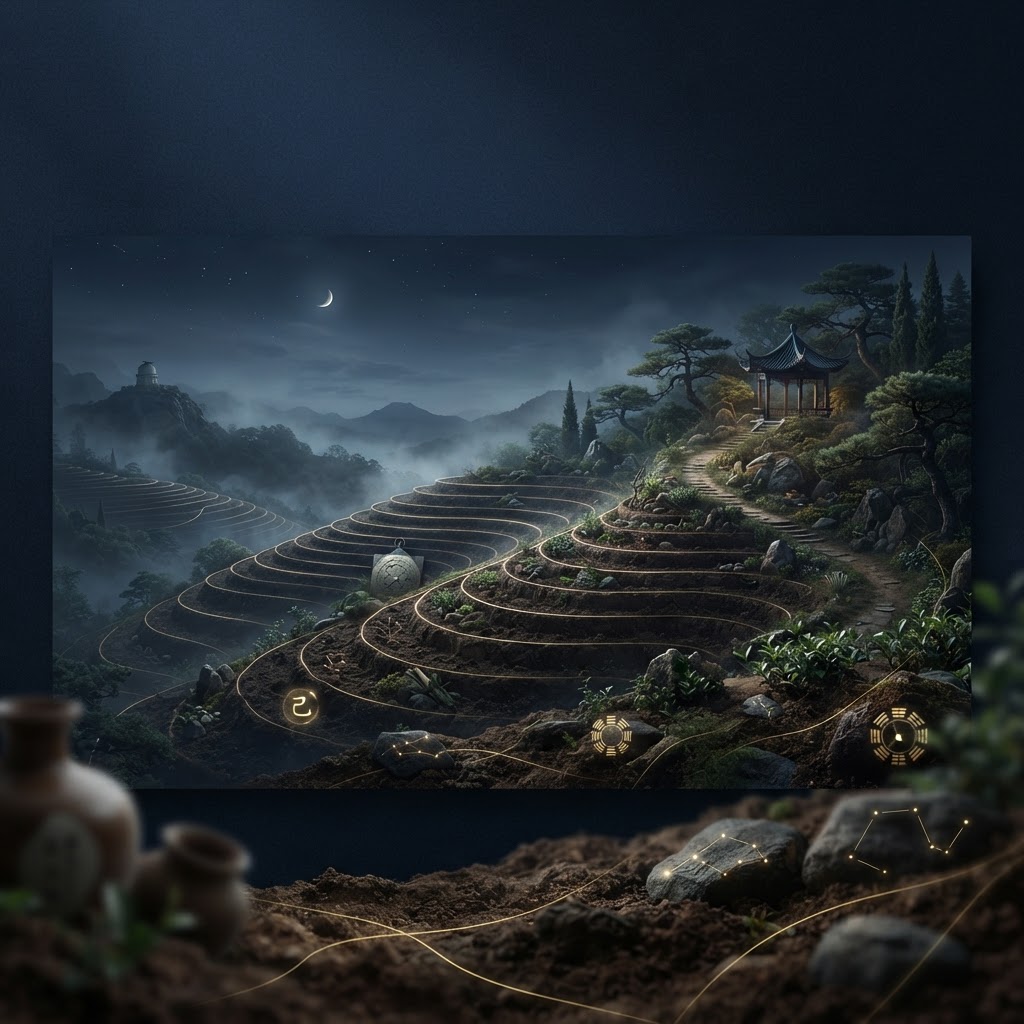
Why Ji Appears as Soil in a Moving Chart
Ji is the sixth heavenly stem. It describes cultivated soil, the ground that receives, sorts, and supports life. In a Qi Men Dun Jia chart, Ji rarely announces itself with spectacle. It shows where material must be prepared, where people need a workable arrangement, and where a vague intention must become a sequence of manageable tasks. I teach it as the second shield around Jia, the hidden leader. Wu is the first shield, broad and protective. Ji is the second, close to the ground and skilled at absorbing pressure without making a display of strength.
Field note 1: turning the image into an action
In a real consultation, I would ask the client to name the material fact behind this section. Is there a document, payment, person, deadline, room, symptom, or promise that can be checked? Ji becomes readable when an image is connected to evidence. Write the fact in one sentence, name the current owner, and choose a review point. Then ask what would count as improvement rather than relying on a feeling of relief. This small discipline keeps the reading grounded and gives the client a way to test the advice. It also protects the reader from making a dramatic claim that the chart cannot support. A chart describes a pattern at a particular time. It does not remove choice, responsibility, or the need for competent professional help where the matter concerns law, medicine, or finance.
The Field Before the Decision
Imagine a project team arriving before a difficult meeting. The agenda is not yet printed, the numbers sit in three spreadsheets, and each department uses a different definition of success. A student may ask which direction is lucky. I ask a prior question: what ground will allow the decision to stand? Ji is present in that preparation. It is the soil in which a plan can take root, but it also records every neglected assumption. Dry soil rejects water. Waterlogged soil cannot hold a foundation. The symbol becomes useful only when you read its condition.
Field note 2: turning the image into an action
In a real consultation, I would ask the client to name the material fact behind this section. Is there a document, payment, person, deadline, room, symptom, or promise that can be checked? Ji becomes readable when an image is connected to evidence. Write the fact in one sentence, name the current owner, and choose a review point. Then ask what would count as improvement rather than relying on a feeling of relief. This small discipline keeps the reading grounded and gives the client a way to test the advice. It also protects the reader from making a dramatic claim that the chart cannot support. A chart describes a pattern at a particular time. It does not remove choice, responsibility, or the need for competent professional help where the matter concerns law, medicine, or finance.
Jia and the Six Protective Hiding Places
Jia is hidden under six stems: Jia-Zi under Wu, Jia-Xu under Ji, Jia-Shen under Geng, Jia-Wu under Ren, Jia-Chen under Gui, and Jia-Yin under Yi. Ji therefore has a precise strategic role. When Jia-Xu is active, leadership is sheltered inside Ji. The chart does not say that Ji is automatically benevolent. It says authority may be operating through administration, custody, obligation, or a practical container. A consultation improves when we identify what the container is protecting and what it is preventing from moving.
Field note 3: turning the image into an action
In a real consultation, I would ask the client to name the material fact behind this section. Is there a document, payment, person, deadline, room, symptom, or promise that can be checked? Ji becomes readable when an image is connected to evidence. Write the fact in one sentence, name the current owner, and choose a review point. Then ask what would count as improvement rather than relying on a feeling of relief. This small discipline keeps the reading grounded and gives the client a way to test the advice. It also protects the reader from making a dramatic claim that the chart cannot support. A chart describes a pattern at a particular time. It does not remove choice, responsibility, or the need for competent professional help where the matter concerns law, medicine, or finance.
Ji as Mediation Rather Than Passivity
People often call earth slow and stop there. That is not enough. Ji is active mediation. It separates useful material from waste, gives boundaries to a process, and creates a place where incompatible elements can coexist long enough to be understood. In a negotiation, Ji may be the agenda, the escrow account, the project manager, or the written definition of delivery. If the structure is sound, it reduces heat. If it is weak, every disagreement becomes personal because nobody trusts the ground beneath the conversation.
Field note 4: turning the image into an action
In a real consultation, I would ask the client to name the material fact behind this section. Is there a document, payment, person, deadline, room, symptom, or promise that can be checked? Ji becomes readable when an image is connected to evidence. Write the fact in one sentence, name the current owner, and choose a review point. Then ask what would count as improvement rather than relying on a feeling of relief. This small discipline keeps the reading grounded and gives the client a way to test the advice. It also protects the reader from making a dramatic claim that the chart cannot support. A chart describes a pattern at a particular time. It does not remove choice, responsibility, or the need for competent professional help where the matter concerns law, medicine, or finance.
A First Reading Method
Start with the question, then locate the Ji stem. Note its palace, door, star, deity, and relation to the asker. Read the combination as a sentence. For example, Ji with the View Door in the Southeast Palace can describe documentation that clarifies a commercial conversation. Ji with the Obstruct Door in the Northeast Palace can describe a useful pause caused by missing records. Neither combination is a verdict. The palace supplies environment, the door supplies the type of movement, the star supplies the quality of force, and the deity supplies the social or psychological atmosphere.
Field note 5: turning the image into an action
In a real consultation, I would ask the client to name the material fact behind this section. Is there a document, payment, person, deadline, room, symptom, or promise that can be checked? Ji becomes readable when an image is connected to evidence. Write the fact in one sentence, name the current owner, and choose a review point. Then ask what would count as improvement rather than relying on a feeling of relief. This small discipline keeps the reading grounded and gives the client a way to test the advice. It also protects the reader from making a dramatic claim that the chart cannot support. A chart describes a pattern at a particular time. It does not remove choice, responsibility, or the need for competent professional help where the matter concerns law, medicine, or finance.
The Earth Element and the Shape of Responsibility
Ji belongs to earth, but the five phases are not a list of personality labels. They are a model of relationships. Earth receives fire, generates metal, restrains water, and is restrained by wood. In a chart, ask what Ji is receiving and what it must support. A team may have excellent ideas, yet Ji shows that the immediate task is not ideation. It may be budgeting, staffing, compliance, or a repair to the operating rhythm. Responsibility becomes visible when we ask what must be carried before anything can expand.
Field note 6: turning the image into an action
In a real consultation, I would ask the client to name the material fact behind this section. Is there a document, payment, person, deadline, room, symptom, or promise that can be checked? Ji becomes readable when an image is connected to evidence. Write the fact in one sentence, name the current owner, and choose a review point. Then ask what would count as improvement rather than relying on a feeling of relief. This small discipline keeps the reading grounded and gives the client a way to test the advice. It also protects the reader from making a dramatic claim that the chart cannot support. A chart describes a pattern at a particular time. It does not remove choice, responsibility, or the need for competent professional help where the matter concerns law, medicine, or finance.
A Worked Business Question
A founder asked whether to sign a regional distribution agreement during a Ji hour. The relevant palace held Ji with the Partner Deity and the View Door. The agreement was not simply a lucky yes. The chart favored a transparent structure, named responsibilities, and a document that made performance visible. We divided the choice into three actions: request a territory schedule, define payment triggers, and create a review date after the first shipment. The founder signed only after those conditions were written. Three months later, the practical clauses mattered more than the excitement of the original meeting.
Field note 7: turning the image into an action
In a real consultation, I would ask the client to name the material fact behind this section. Is there a document, payment, person, deadline, room, symptom, or promise that can be checked? Ji becomes readable when an image is connected to evidence. Write the fact in one sentence, name the current owner, and choose a review point. Then ask what would count as improvement rather than relying on a feeling of relief. This small discipline keeps the reading grounded and gives the client a way to test the advice. It also protects the reader from making a dramatic claim that the chart cannot support. A chart describes a pattern at a particular time. It does not remove choice, responsibility, or the need for competent professional help where the matter concerns law, medicine, or finance.
A Worked Personal Question
A client asked why a family renovation had stalled. Ji appeared in a palace associated with the matter, alongside the Injury Door. The reading did not predict disaster. It showed accumulated small damage: unclear ownership of decisions, repeated changes to materials, and a contractor waiting for one person to approve the budget. We created a one-page decision register. Every change received a cost, an owner, and a date. The work resumed. Ji had described the repair of the process, not a supernatural obstacle.
Field note 8: turning the image into an action
In a real consultation, I would ask the client to name the material fact behind this section. Is there a document, payment, person, deadline, room, symptom, or promise that can be checked? Ji becomes readable when an image is connected to evidence. Write the fact in one sentence, name the current owner, and choose a review point. Then ask what would count as improvement rather than relying on a feeling of relief. This small discipline keeps the reading grounded and gives the client a way to test the advice. It also protects the reader from making a dramatic claim that the chart cannot support. A chart describes a pattern at a particular time. It does not remove choice, responsibility, or the need for competent professional help where the matter concerns law, medicine, or finance.
Ji in the Nine Palaces
The same stem changes expression as it travels through the palaces. In the North, Ji may ask for quiet consolidation and a stronger reserve. In the Northeast, it may emphasize a boundary or a new foundation. In the East, the soil must accommodate growth without smothering it. In the Southeast, records, trade, and communication need structure. In the South, visible recognition must be backed by substance. In the Southwest, family or team obligations become central. In the West, enjoyment needs completion. In the Northwest, authority is measured by stewardship. In the Center, the whole chart is asked to carry weight.
Field note 9: turning the image into an action
In a real consultation, I would ask the client to name the material fact behind this section. Is there a document, payment, person, deadline, room, symptom, or promise that can be checked? Ji becomes readable when an image is connected to evidence. Write the fact in one sentence, name the current owner, and choose a review point. Then ask what would count as improvement rather than relying on a feeling of relief. This small discipline keeps the reading grounded and gives the client a way to test the advice. It also protects the reader from making a dramatic claim that the chart cannot support. A chart describes a pattern at a particular time. It does not remove choice, responsibility, or the need for competent professional help where the matter concerns law, medicine, or finance.
Ji in the North Without Rushing
The North Palace is associated with water, rest, and hidden roots. Ji there can show a need to protect resources while the next move is still forming. I would not use it to justify fear or indefinite delay. I would ask what reserve is missing. A person changing careers may need six months of expenses, a portfolio, and a conversation with a former colleague. These are earthy actions. They turn an anxious pause into a controlled preparation period.
Field note 10: turning the image into an action
In a real consultation, I would ask the client to name the material fact behind this section. Is there a document, payment, person, deadline, room, symptom, or promise that can be checked? Ji becomes readable when an image is connected to evidence. Write the fact in one sentence, name the current owner, and choose a review point. Then ask what would count as improvement rather than relying on a feeling of relief. This small discipline keeps the reading grounded and gives the client a way to test the advice. It also protects the reader from making a dramatic claim that the chart cannot support. A chart describes a pattern at a particular time. It does not remove choice, responsibility, or the need for competent professional help where the matter concerns law, medicine, or finance.
Ji in the Northeast at the Threshold
The Northeast Palace has the quality of a mountain and a threshold. Ji here often rewards clear limits. A project may need a smaller first version, a defined admission rule, or a single person authorized to say no. The mountain does not move because the room is impatient. It gives the work a contour. When the contour is right, movement becomes easier because energy is no longer leaking through every edge.
Field note 11: turning the image into an action
In a real consultation, I would ask the client to name the material fact behind this section. Is there a document, payment, person, deadline, room, symptom, or promise that can be checked? Ji becomes readable when an image is connected to evidence. Write the fact in one sentence, name the current owner, and choose a review point. Then ask what would count as improvement rather than relying on a feeling of relief. This small discipline keeps the reading grounded and gives the client a way to test the advice. It also protects the reader from making a dramatic claim that the chart cannot support. A chart describes a pattern at a particular time. It does not remove choice, responsibility, or the need for competent professional help where the matter concerns law, medicine, or finance.
Ji in the East Where Growth Needs Room
The East Palace carries wood and the force of spring. Ji here is not a command to suppress growth. It asks whether growth has enough soil, water, staff, and time. A marketing campaign can generate demand faster than operations can serve it. A new relationship can move faster than trust can develop. Read Ji as the capacity question. What must be increased before the visible growth becomes sustainable?
Field note 12: turning the image into an action
In a real consultation, I would ask the client to name the material fact behind this section. Is there a document, payment, person, deadline, room, symptom, or promise that can be checked? Ji becomes readable when an image is connected to evidence. Write the fact in one sentence, name the current owner, and choose a review point. Then ask what would count as improvement rather than relying on a feeling of relief. This small discipline keeps the reading grounded and gives the client a way to test the advice. It also protects the reader from making a dramatic claim that the chart cannot support. A chart describes a pattern at a particular time. It does not remove choice, responsibility, or the need for competent professional help where the matter concerns law, medicine, or finance.
Ji in the Southeast and the Paper Trail
The Southeast Palace is associated with wind, spreading influence, wealth movement, and communication. Ji here often makes the paper trail decisive. Proposals, invoices, terms, permissions, and handover notes are not clerical extras. They are the soil through which the commercial wind moves. If a message keeps being misunderstood, change the structure of the message. Use one page, one owner, one requested response, and one date.
Field note 13: turning the image into an action
In a real consultation, I would ask the client to name the material fact behind this section. Is there a document, payment, person, deadline, room, symptom, or promise that can be checked? Ji becomes readable when an image is connected to evidence. Write the fact in one sentence, name the current owner, and choose a review point. Then ask what would count as improvement rather than relying on a feeling of relief. This small discipline keeps the reading grounded and gives the client a way to test the advice. It also protects the reader from making a dramatic claim that the chart cannot support. A chart describes a pattern at a particular time. It does not remove choice, responsibility, or the need for competent professional help where the matter concerns law, medicine, or finance.
Ji in the South Under Bright Attention
The South Palace brings fire, visibility, and recognition. Ji there asks whether the public image is supported by a real delivery system. A speaker may be invited onto a large stage while the course materials are unfinished. A brand may look polished while its refunds process is unclear. Ji does not oppose visibility. It insists that visibility rests on something that can bear scrutiny.
Field note 14: turning the image into an action
In a real consultation, I would ask the client to name the material fact behind this section. Is there a document, payment, person, deadline, room, symptom, or promise that can be checked? Ji becomes readable when an image is connected to evidence. Write the fact in one sentence, name the current owner, and choose a review point. Then ask what would count as improvement rather than relying on a feeling of relief. This small discipline keeps the reading grounded and gives the client a way to test the advice. It also protects the reader from making a dramatic claim that the chart cannot support. A chart describes a pattern at a particular time. It does not remove choice, responsibility, or the need for competent professional help where the matter concerns law, medicine, or finance.
Ji in the Southwest and Shared Duties
The Southwest Palace points toward earth, nourishment, family, and shared obligations. Ji here can describe the work of making care practical. In a household, that may mean schedules, medical records, transport, and financial limits. In a team, it may mean workload allocation and a fair escalation path. Good intentions are not enough. Ji asks who does what, by when, and with which support.
Field note 15: turning the image into an action
In a real consultation, I would ask the client to name the material fact behind this section. Is there a document, payment, person, deadline, room, symptom, or promise that can be checked? Ji becomes readable when an image is connected to evidence. Write the fact in one sentence, name the current owner, and choose a review point. Then ask what would count as improvement rather than relying on a feeling of relief. This small discipline keeps the reading grounded and gives the client a way to test the advice. It also protects the reader from making a dramatic claim that the chart cannot support. A chart describes a pattern at a particular time. It does not remove choice, responsibility, or the need for competent professional help where the matter concerns law, medicine, or finance.
Ji in the West and the Pleasure of Finishing
The West Palace is metal, completion, speech, and measured enjoyment. Ji there may reveal that pleasure is being postponed because small unfinished obligations remain everywhere. Close the loop on the quotation, the invoice, the promised call, or the final edit. Completion changes the emotional temperature of a project. It lets people celebrate without secretly carrying a list of unresolved tasks.
Field note 16: turning the image into an action
In a real consultation, I would ask the client to name the material fact behind this section. Is there a document, payment, person, deadline, room, symptom, or promise that can be checked? Ji becomes readable when an image is connected to evidence. Write the fact in one sentence, name the current owner, and choose a review point. Then ask what would count as improvement rather than relying on a feeling of relief. This small discipline keeps the reading grounded and gives the client a way to test the advice. It also protects the reader from making a dramatic claim that the chart cannot support. A chart describes a pattern at a particular time. It does not remove choice, responsibility, or the need for competent professional help where the matter concerns law, medicine, or finance.
Ji in the Northwest and the Weight of Office
The Northwest Palace carries authority, heaven, senior figures, and leadership. Ji here often tests whether authority is serving the whole structure. A manager who holds every decision creates a heavy, compacted soil. A manager who sets standards and delegates creates a field that others can cultivate. If the reading concerns a senior person, examine their duty, not just their status.
Field note 17: turning the image into an action
In a real consultation, I would ask the client to name the material fact behind this section. Is there a document, payment, person, deadline, room, symptom, or promise that can be checked? Ji becomes readable when an image is connected to evidence. Write the fact in one sentence, name the current owner, and choose a review point. Then ask what would count as improvement rather than relying on a feeling of relief. This small discipline keeps the reading grounded and gives the client a way to test the advice. It also protects the reader from making a dramatic claim that the chart cannot support. A chart describes a pattern at a particular time. It does not remove choice, responsibility, or the need for competent professional help where the matter concerns law, medicine, or finance.
Ji in the Center as the Load Bearing Point
The Center is not an ordinary direction. It is the chart’s point of balance and command. Ji in the Center can describe an issue that touches every part of the question. Do not force a narrow interpretation. Ask which assumption is shared by all participants. A budget, a definition, a health baseline, or a central promise may need repair before any directional choice makes sense.
Field note 18: turning the image into an action
In a real consultation, I would ask the client to name the material fact behind this section. Is there a document, payment, person, deadline, room, symptom, or promise that can be checked? Ji becomes readable when an image is connected to evidence. Write the fact in one sentence, name the current owner, and choose a review point. Then ask what would count as improvement rather than relying on a feeling of relief. This small discipline keeps the reading grounded and gives the client a way to test the advice. It also protects the reader from making a dramatic claim that the chart cannot support. A chart describes a pattern at a particular time. It does not remove choice, responsibility, or the need for competent professional help where the matter concerns law, medicine, or finance.
Doors That Help Ji Speak
The doors give Ji a practical verb. The Open Door can make prepared material available. The Rest Door can protect a recovery period. The Life Door can help a plan grow. The Injury Door can expose damage in the foundation. The Obstruct Door can show confusion or missing information. The View Door can make records visible. The Death Door can end an arrangement that no longer carries weight. The Dispute Door can bring conflict into the open so terms can be tested.
Field note 19: turning the image into an action
In a real consultation, I would ask the client to name the material fact behind this section. Is there a document, payment, person, deadline, room, symptom, or promise that can be checked? Ji becomes readable when an image is connected to evidence. Write the fact in one sentence, name the current owner, and choose a review point. Then ask what would count as improvement rather than relying on a feeling of relief. This small discipline keeps the reading grounded and gives the client a way to test the advice. It also protects the reader from making a dramatic claim that the chart cannot support. A chart describes a pattern at a particular time. It does not remove choice, responsibility, or the need for competent professional help where the matter concerns law, medicine, or finance.
Stars That Change the Texture
Stars describe the quality of effort surrounding Ji. The Bandit Star may show appetite, risk, or a competitor taking resources. The Problem Star can point to illness, defects, and slow repair. The Impulse Star brings speed and force. The Advisor Star helps coordination and learning. The Minister Star adds authority and guardianship. The Diplomat Star favors precision, medicine, and clean edges. The Destroyer Star cuts away. The Doctor Star supports endurance and repair. The Fearless Star makes the matter visible and hot. Match the star to the question rather than using a fixed good or bad list.
Field note 20: turning the image into an action
In a real consultation, I would ask the client to name the material fact behind this section. Is there a document, payment, person, deadline, room, symptom, or promise that can be checked? Ji becomes readable when an image is connected to evidence. Write the fact in one sentence, name the current owner, and choose a review point. Then ask what would count as improvement rather than relying on a feeling of relief. This small discipline keeps the reading grounded and gives the client a way to test the advice. It also protects the reader from making a dramatic claim that the chart cannot support. A chart describes a pattern at a particular time. It does not remove choice, responsibility, or the need for competent professional help where the matter concerns law, medicine, or finance.
Deities and the Social Atmosphere
A deity tells us how people may experience the arrangement. The Leader Deity can place Ji under command. The Serpent can bring worry, twists, or changing paths. Darkness favors quiet support. The Partner Deity helps alliances and middlemen. The White Tiger adds pressure and hard contact. The Black Tortoise warns of hidden motives or slow erosion. Nine Earth stabilizes and stores. Nine Heaven lifts the matter toward reach and expansion. With Ji, these atmospheres describe how the ground is managed.
Field note 21: turning the image into an action
In a real consultation, I would ask the client to name the material fact behind this section. Is there a document, payment, person, deadline, room, symptom, or promise that can be checked? Ji becomes readable when an image is connected to evidence. Write the fact in one sentence, name the current owner, and choose a review point. Then ask what would count as improvement rather than relying on a feeling of relief. This small discipline keeps the reading grounded and gives the client a way to test the advice. It also protects the reader from making a dramatic claim that the chart cannot support. A chart describes a pattern at a particular time. It does not remove choice, responsibility, or the need for competent professional help where the matter concerns law, medicine, or finance.
A Concrete Hour Chart Example
Consider an hour chart with Ji in Palace Two, the Southwest Palace, together with the View Door, the Doctor Star, and Nine Earth. Suppose the ju is Yang Dun 3, an hour chart within the 1080 ju cycle. The combination supports an audit, care plan, handover, or family agreement. It does not promise that every participant will cooperate. Use the hour to make the material visible, assign owners, and create a record that survives memory. The reading becomes operational when the client knows the next three actions.
Field note 22: turning the image into an action
In a real consultation, I would ask the client to name the material fact behind this section. Is there a document, payment, person, deadline, room, symptom, or promise that can be checked? Ji becomes readable when an image is connected to evidence. Write the fact in one sentence, name the current owner, and choose a review point. Then ask what would count as improvement rather than relying on a feeling of relief. This small discipline keeps the reading grounded and gives the client a way to test the advice. It also protects the reader from making a dramatic claim that the chart cannot support. A chart describes a pattern at a particular time. It does not remove choice, responsibility, or the need for competent professional help where the matter concerns law, medicine, or finance.
Another Example With Pressure
Now imagine Ji in Palace Seven with the Injury Door, the Problem Star, and the White Tiger. The matter may involve damage, criticism, or a costly repair. The correct response is not panic. Isolate the damaged part, obtain independent evidence, and avoid signing a broad admission before the facts are clear. Ji gives the situation a repairable container. The difficult combination tells us to inspect the container honestly.
Field note 23: turning the image into an action
In a real consultation, I would ask the client to name the material fact behind this section. Is there a document, payment, person, deadline, room, symptom, or promise that can be checked? Ji becomes readable when an image is connected to evidence. Write the fact in one sentence, name the current owner, and choose a review point. Then ask what would count as improvement rather than relying on a feeling of relief. This small discipline keeps the reading grounded and gives the client a way to test the advice. It also protects the reader from making a dramatic claim that the chart cannot support. A chart describes a pattern at a particular time. It does not remove choice, responsibility, or the need for competent professional help where the matter concerns law, medicine, or finance.
Choosing a Direction Without Superstition
Direction selection can be useful when it is tied to a real action. If a meeting concerns documentation and Ji with the View Door is available in a supportive palace, choose that direction for the first call or for arranging the documents. Do not wander around a building hoping the compass will replace preparation. A direction is a timing and positioning aid. It does not cancel contracts, skill, evidence, or human responsibility.
Field note 24: turning the image into an action
In a real consultation, I would ask the client to name the material fact behind this section. Is there a document, payment, person, deadline, room, symptom, or promise that can be checked? Ji becomes readable when an image is connected to evidence. Write the fact in one sentence, name the current owner, and choose a review point. Then ask what would count as improvement rather than relying on a feeling of relief. This small discipline keeps the reading grounded and gives the client a way to test the advice. It also protects the reader from making a dramatic claim that the chart cannot support. A chart describes a pattern at a particular time. It does not remove choice, responsibility, or the need for competent professional help where the matter concerns law, medicine, or finance.
The Difference Between Support and Excuse
A favorable Ji combination can support a plan, but it cannot excuse poor execution. I have seen people find a promising hour and then arrive without the figures, the authority, or the required consent. I have also seen people with a difficult chart make a sound decision by narrowing the scope and building a record. Qi Men Dun Jia is strongest when it improves judgment. It becomes weak when used to avoid judgment.
Field note 25: turning the image into an action
In a real consultation, I would ask the client to name the material fact behind this section. Is there a document, payment, person, deadline, room, symptom, or promise that can be checked? Ji becomes readable when an image is connected to evidence. Write the fact in one sentence, name the current owner, and choose a review point. Then ask what would count as improvement rather than relying on a feeling of relief. This small discipline keeps the reading grounded and gives the client a way to test the advice. It also protects the reader from making a dramatic claim that the chart cannot support. A chart describes a pattern at a particular time. It does not remove choice, responsibility, or the need for competent professional help where the matter concerns law, medicine, or finance.
How Ji Relates to the Hidden Leader
The hidden Jia is the strategic subject of the chart, yet the visible stem around it often shows the conditions of leadership. Ji can indicate the administrative body protecting the leader, the obligations that make command legitimate, or the soil in which an instruction must land. Ask whether the leader is protected by a useful structure or buried under one. The answer changes the advice. A shield should absorb impact, not prevent all movement.
Field note 26: turning the image into an action
In a real consultation, I would ask the client to name the material fact behind this section. Is there a document, payment, person, deadline, room, symptom, or promise that can be checked? Ji becomes readable when an image is connected to evidence. Write the fact in one sentence, name the current owner, and choose a review point. Then ask what would count as improvement rather than relying on a feeling of relief. This small discipline keeps the reading grounded and gives the client a way to test the advice. It also protects the reader from making a dramatic claim that the chart cannot support. A chart describes a pattern at a particular time. It does not remove choice, responsibility, or the need for competent professional help where the matter concerns law, medicine, or finance.
A Teaching Exercise for Students
Take a question about a delayed proposal. Record the time, locate Ji, and write five plain sentences. What is the material? What needs sorting? What is being protected? What is compacted or neglected? What single action would improve the ground within forty-eight hours? Only after this should you add the palace, door, star, and deity. The exercise prevents students from hiding behind vocabulary. The chart must return to a decision that a person can actually make.
Field note 27: turning the image into an action
In a real consultation, I would ask the client to name the material fact behind this section. Is there a document, payment, person, deadline, room, symptom, or promise that can be checked? Ji becomes readable when an image is connected to evidence. Write the fact in one sentence, name the current owner, and choose a review point. Then ask what would count as improvement rather than relying on a feeling of relief. This small discipline keeps the reading grounded and gives the client a way to test the advice. It also protects the reader from making a dramatic claim that the chart cannot support. A chart describes a pattern at a particular time. It does not remove choice, responsibility, or the need for competent professional help where the matter concerns law, medicine, or finance.
Common Errors in Reading Ji
The first error is treating Ji as merely weak earth. The second is assuming every earth symbol means property or family. The third is giving a moral judgment to the client instead of describing a condition. The fourth is overlooking the question’s time frame. A Ji hour may be excellent for organizing and poor for public launch. The fifth is refusing to act because preparation is never considered complete. Soil must be prepared, then planted.
Field note 28: turning the image into an action
In a real consultation, I would ask the client to name the material fact behind this section. Is there a document, payment, person, deadline, room, symptom, or promise that can be checked? Ji becomes readable when an image is connected to evidence. Write the fact in one sentence, name the current owner, and choose a review point. Then ask what would count as improvement rather than relying on a feeling of relief. This small discipline keeps the reading grounded and gives the client a way to test the advice. It also protects the reader from making a dramatic claim that the chart cannot support. A chart describes a pattern at a particular time. It does not remove choice, responsibility, or the need for competent professional help where the matter concerns law, medicine, or finance.
FAQ: Is Ji Always Slow?
No. Ji is deliberate more often than fast, but the door and surrounding structure can accelerate the work. Ji with the Impulse Star may support rapid mobilization if the process is clear. Ji with the Open Door may release a prepared plan immediately. The point is not speed alone. It is whether speed leaves the arrangement stronger or scattered.
Field note 29: turning the image into an action
In a real consultation, I would ask the client to name the material fact behind this section. Is there a document, payment, person, deadline, room, symptom, or promise that can be checked? Ji becomes readable when an image is connected to evidence. Write the fact in one sentence, name the current owner, and choose a review point. Then ask what would count as improvement rather than relying on a feeling of relief. This small discipline keeps the reading grounded and gives the client a way to test the advice. It also protects the reader from making a dramatic claim that the chart cannot support. A chart describes a pattern at a particular time. It does not remove choice, responsibility, or the need for competent professional help where the matter concerns law, medicine, or finance.
FAQ: Is Ji Bad for Money?
No. Ji can be very practical for money because it concerns reserves, allocation, records, and value that can be sustained. A difficult combination may warn of hidden costs or poor accounting. A supportive combination may favor budgeting, pricing, storage, or contract administration. Always read the actual financial question and inspect the relevant palace.
Field note 30: turning the image into an action
In a real consultation, I would ask the client to name the material fact behind this section. Is there a document, payment, person, deadline, room, symptom, or promise that can be checked? Ji becomes readable when an image is connected to evidence. Write the fact in one sentence, name the current owner, and choose a review point. Then ask what would count as improvement rather than relying on a feeling of relief. This small discipline keeps the reading grounded and gives the client a way to test the advice. It also protects the reader from making a dramatic claim that the chart cannot support. A chart describes a pattern at a particular time. It does not remove choice, responsibility, or the need for competent professional help where the matter concerns law, medicine, or finance.
FAQ: Should I Avoid a Ji Hour?
Avoidance is usually too crude. If the task is to consolidate, audit, repair, negotiate terms, or create a reliable base, Ji may be exactly the right quality. If the task requires immediate spectacle and no preparation, the chart may show why the timing feels heavy. Change the task or change the hour. Do not turn one stem into a universal prohibition.
Field note 31: turning the image into an action
In a real consultation, I would ask the client to name the material fact behind this section. Is there a document, payment, person, deadline, room, symptom, or promise that can be checked? Ji becomes readable when an image is connected to evidence. Write the fact in one sentence, name the current owner, and choose a review point. Then ask what would count as improvement rather than relying on a feeling of relief. This small discipline keeps the reading grounded and gives the client a way to test the advice. It also protects the reader from making a dramatic claim that the chart cannot support. A chart describes a pattern at a particular time. It does not remove choice, responsibility, or the need for competent professional help where the matter concerns law, medicine, or finance.
The Ground Determines the Next Step
A chart becomes useful when it changes what happens after the consultation. For Ji, that next step is often modest but consequential: write the rule, separate the accounts, repair the workflow, name the owner, reduce the scope, or preserve the reserve. These actions may look ordinary. Ordinary is not the same as unimportant. A foundation is ordinary until it fails.
Field note 32: turning the image into an action
In a real consultation, I would ask the client to name the material fact behind this section. Is there a document, payment, person, deadline, room, symptom, or promise that can be checked? Ji becomes readable when an image is connected to evidence. Write the fact in one sentence, name the current owner, and choose a review point. Then ask what would count as improvement rather than relying on a feeling of relief. This small discipline keeps the reading grounded and gives the client a way to test the advice. It also protects the reader from making a dramatic claim that the chart cannot support. A chart describes a pattern at a particular time. It does not remove choice, responsibility, or the need for competent professional help where the matter concerns law, medicine, or finance.
A Final Practice in Disciplined Earth
When I teach this stem, I ask students to imagine a field after rain. Some areas are fertile, some compacted, and some washed away. The reader’s job is not to praise or condemn the field. It is to see where water is moving, where roots can hold, and where a boundary needs rebuilding. Ji gives that practical intelligence a name. Use it to protect what matters, mediate what is tense, and make leadership capable of taking root.
Field note 33: turning the image into an action
In a real consultation, I would ask the client to name the material fact behind this section. Is there a document, payment, person, deadline, room, symptom, or promise that can be checked? Ji becomes readable when an image is connected to evidence. Write the fact in one sentence, name the current owner, and choose a review point. Then ask what would count as improvement rather than relying on a feeling of relief. This small discipline keeps the reading grounded and gives the client a way to test the advice. It also protects the reader from making a dramatic claim that the chart cannot support. A chart describes a pattern at a particular time. It does not remove choice, responsibility, or the need for competent professional help where the matter concerns law, medicine, or finance.
Three Registers for a Ji Consultation
| Register | Question | Evidence | Action |
|---|---|---|---|
| Resources | What must be preserved? | Cash, time, staff, records | Set a reserve and owner |
| Structure | What gives the matter shape? | Terms, sequence, boundary | Write one operating rule |
| Repair | What has been compacted? | Delay, defect, repeated dispute | Inspect and correct the bottleneck |
A Compact Palace Comparison
| Palace | Ji emphasis | Useful test |
|---|---|---|
| North | Reserve and roots | Can the pause be funded? |
| East | Capacity for growth | Can operations carry demand? |
| South | Substance under visibility | Will scrutiny find support? |
| West | Closure and value | What remains unfinished? |
| Center | Shared load | Which assumption affects everyone? |
Questions to Record Before Acting
| Prompt | Plain answer | Review window |
|---|---|---|
| What is being protected? | Write one noun | Today |
| What is being sorted? | List three items | Forty eight hours |
| Who owns the next move? | Name one person | Before the next meeting |
| What proves improvement? | Choose a measure | Seven days |
Ji does not ask you to wait forever. It asks you to make the ground capable of carrying the decision.
A quiet structure can be the strongest protection around visible leadership.
Applied Soil Lesson 1: A More Careful Decision
The practical value of Ji appears in the second look. At first, a client may describe a problem as a lack of luck, a difficult colleague, or a missed opening. Ask what physical or administrative condition sits underneath that description. Perhaps a payment has no approval path, a family has no shared calendar, or a team has no definition of done. Naming the condition changes the conversation. The chart then becomes a way to choose timing and sequence, rather than a machine for producing certainty. In my classes, I ask students to write the recommendation twice, first in symbolic language and then in ordinary language. If the ordinary sentence is vague, the reading is not ready. A useful sentence names an action, an owner, and a reason. Ji prefers this kind of accountable clarity because soil is judged by what it can support, not by how impressive it looks from a distance.
Measure the improvement after lesson 1
Use a short review interval. If the matter concerns a contract, check whether the disputed clause has an agreed meaning. If it concerns health, follow the clinician's plan and record observable changes. If it concerns a project, compare the promised milestone with the delivered artifact. These checks do not reduce the chart to statistics. They protect the client from confusing a persuasive interpretation with a result. A quiet improvement may be more valuable than a dramatic explanation. Ji teaches patience, but it also teaches accountability. When the ground has improved, the next decision often becomes simpler because fewer hidden variables are moving underneath it.
Applied Soil Lesson 2: A More Careful Decision
The practical value of Ji appears in the second look. At first, a client may describe a problem as a lack of luck, a difficult colleague, or a missed opening. Ask what physical or administrative condition sits underneath that description. Perhaps a payment has no approval path, a family has no shared calendar, or a team has no definition of done. Naming the condition changes the conversation. The chart then becomes a way to choose timing and sequence, rather than a machine for producing certainty. In my classes, I ask students to write the recommendation twice, first in symbolic language and then in ordinary language. If the ordinary sentence is vague, the reading is not ready. A useful sentence names an action, an owner, and a reason. Ji prefers this kind of accountable clarity because soil is judged by what it can support, not by how impressive it looks from a distance.
Measure the improvement after lesson 2
Use a short review interval. If the matter concerns a contract, check whether the disputed clause has an agreed meaning. If it concerns health, follow the clinician's plan and record observable changes. If it concerns a project, compare the promised milestone with the delivered artifact. These checks do not reduce the chart to statistics. They protect the client from confusing a persuasive interpretation with a result. A quiet improvement may be more valuable than a dramatic explanation. Ji teaches patience, but it also teaches accountability. When the ground has improved, the next decision often becomes simpler because fewer hidden variables are moving underneath it.
Applied Soil Lesson 3: A More Careful Decision
The practical value of Ji appears in the second look. At first, a client may describe a problem as a lack of luck, a difficult colleague, or a missed opening. Ask what physical or administrative condition sits underneath that description. Perhaps a payment has no approval path, a family has no shared calendar, or a team has no definition of done. Naming the condition changes the conversation. The chart then becomes a way to choose timing and sequence, rather than a machine for producing certainty. In my classes, I ask students to write the recommendation twice, first in symbolic language and then in ordinary language. If the ordinary sentence is vague, the reading is not ready. A useful sentence names an action, an owner, and a reason. Ji prefers this kind of accountable clarity because soil is judged by what it can support, not by how impressive it looks from a distance.
Measure the improvement after lesson 3
Use a short review interval. If the matter concerns a contract, check whether the disputed clause has an agreed meaning. If it concerns health, follow the clinician's plan and record observable changes. If it concerns a project, compare the promised milestone with the delivered artifact. These checks do not reduce the chart to statistics. They protect the client from confusing a persuasive interpretation with a result. A quiet improvement may be more valuable than a dramatic explanation. Ji teaches patience, but it also teaches accountability. When the ground has improved, the next decision often becomes simpler because fewer hidden variables are moving underneath it.
Applied Soil Lesson 4: A More Careful Decision
The practical value of Ji appears in the second look. At first, a client may describe a problem as a lack of luck, a difficult colleague, or a missed opening. Ask what physical or administrative condition sits underneath that description. Perhaps a payment has no approval path, a family has no shared calendar, or a team has no definition of done. Naming the condition changes the conversation. The chart then becomes a way to choose timing and sequence, rather than a machine for producing certainty. In my classes, I ask students to write the recommendation twice, first in symbolic language and then in ordinary language. If the ordinary sentence is vague, the reading is not ready. A useful sentence names an action, an owner, and a reason. Ji prefers this kind of accountable clarity because soil is judged by what it can support, not by how impressive it looks from a distance.
Measure the improvement after lesson 4
Use a short review interval. If the matter concerns a contract, check whether the disputed clause has an agreed meaning. If it concerns health, follow the clinician's plan and record observable changes. If it concerns a project, compare the promised milestone with the delivered artifact. These checks do not reduce the chart to statistics. They protect the client from confusing a persuasive interpretation with a result. A quiet improvement may be more valuable than a dramatic explanation. Ji teaches patience, but it also teaches accountability. When the ground has improved, the next decision often becomes simpler because fewer hidden variables are moving underneath it.
Applied Soil Lesson 5: A More Careful Decision
The practical value of Ji appears in the second look. At first, a client may describe a problem as a lack of luck, a difficult colleague, or a missed opening. Ask what physical or administrative condition sits underneath that description. Perhaps a payment has no approval path, a family has no shared calendar, or a team has no definition of done. Naming the condition changes the conversation. The chart then becomes a way to choose timing and sequence, rather than a machine for producing certainty. In my classes, I ask students to write the recommendation twice, first in symbolic language and then in ordinary language. If the ordinary sentence is vague, the reading is not ready. A useful sentence names an action, an owner, and a reason. Ji prefers this kind of accountable clarity because soil is judged by what it can support, not by how impressive it looks from a distance.
Measure the improvement after lesson 5
Use a short review interval. If the matter concerns a contract, check whether the disputed clause has an agreed meaning. If it concerns health, follow the clinician's plan and record observable changes. If it concerns a project, compare the promised milestone with the delivered artifact. These checks do not reduce the chart to statistics. They protect the client from confusing a persuasive interpretation with a result. A quiet improvement may be more valuable than a dramatic explanation. Ji teaches patience, but it also teaches accountability. When the ground has improved, the next decision often becomes simpler because fewer hidden variables are moving underneath it.
Applied Soil Lesson 6: A More Careful Decision
The practical value of Ji appears in the second look. At first, a client may describe a problem as a lack of luck, a difficult colleague, or a missed opening. Ask what physical or administrative condition sits underneath that description. Perhaps a payment has no approval path, a family has no shared calendar, or a team has no definition of done. Naming the condition changes the conversation. The chart then becomes a way to choose timing and sequence, rather than a machine for producing certainty. In my classes, I ask students to write the recommendation twice, first in symbolic language and then in ordinary language. If the ordinary sentence is vague, the reading is not ready. A useful sentence names an action, an owner, and a reason. Ji prefers this kind of accountable clarity because soil is judged by what it can support, not by how impressive it looks from a distance.
Measure the improvement after lesson 6
Use a short review interval. If the matter concerns a contract, check whether the disputed clause has an agreed meaning. If it concerns health, follow the clinician's plan and record observable changes. If it concerns a project, compare the promised milestone with the delivered artifact. These checks do not reduce the chart to statistics. They protect the client from confusing a persuasive interpretation with a result. A quiet improvement may be more valuable than a dramatic explanation. Ji teaches patience, but it also teaches accountability. When the ground has improved, the next decision often becomes simpler because fewer hidden variables are moving underneath it.
Applied Soil Lesson 7: A More Careful Decision
The practical value of Ji appears in the second look. At first, a client may describe a problem as a lack of luck, a difficult colleague, or a missed opening. Ask what physical or administrative condition sits underneath that description. Perhaps a payment has no approval path, a family has no shared calendar, or a team has no definition of done. Naming the condition changes the conversation. The chart then becomes a way to choose timing and sequence, rather than a machine for producing certainty. In my classes, I ask students to write the recommendation twice, first in symbolic language and then in ordinary language. If the ordinary sentence is vague, the reading is not ready. A useful sentence names an action, an owner, and a reason. Ji prefers this kind of accountable clarity because soil is judged by what it can support, not by how impressive it looks from a distance.
Measure the improvement after lesson 7
Use a short review interval. If the matter concerns a contract, check whether the disputed clause has an agreed meaning. If it concerns health, follow the clinician's plan and record observable changes. If it concerns a project, compare the promised milestone with the delivered artifact. These checks do not reduce the chart to statistics. They protect the client from confusing a persuasive interpretation with a result. A quiet improvement may be more valuable than a dramatic explanation. Ji teaches patience, but it also teaches accountability. When the ground has improved, the next decision often becomes simpler because fewer hidden variables are moving underneath it.
Applied Soil Lesson 8: A More Careful Decision
The practical value of Ji appears in the second look. At first, a client may describe a problem as a lack of luck, a difficult colleague, or a missed opening. Ask what physical or administrative condition sits underneath that description. Perhaps a payment has no approval path, a family has no shared calendar, or a team has no definition of done. Naming the condition changes the conversation. The chart then becomes a way to choose timing and sequence, rather than a machine for producing certainty. In my classes, I ask students to write the recommendation twice, first in symbolic language and then in ordinary language. If the ordinary sentence is vague, the reading is not ready. A useful sentence names an action, an owner, and a reason. Ji prefers this kind of accountable clarity because soil is judged by what it can support, not by how impressive it looks from a distance.
Measure the improvement after lesson 8
Use a short review interval. If the matter concerns a contract, check whether the disputed clause has an agreed meaning. If it concerns health, follow the clinician's plan and record observable changes. If it concerns a project, compare the promised milestone with the delivered artifact. These checks do not reduce the chart to statistics. They protect the client from confusing a persuasive interpretation with a result. A quiet improvement may be more valuable than a dramatic explanation. Ji teaches patience, but it also teaches accountability. When the ground has improved, the next decision often becomes simpler because fewer hidden variables are moving underneath it.
Continue the Larger Study
For the wider architecture, return to the Qi Men Dun Jia foundation guide, then compare this stem with the Wu Stem, the Geng Stem, and the ten heavenly stems overview. The goal is not to memorize a label. It is to see how a chart turns a question into a responsible next move.
Return to the main Qi Men Dun Jia guide when you want to connect Ji with palaces, doors, stars, deities, and timing. Read the chart patiently, test its advice against facts, and let the ground become strong enough for the decision you intend to make.