Why the Middle Square Changes the Question
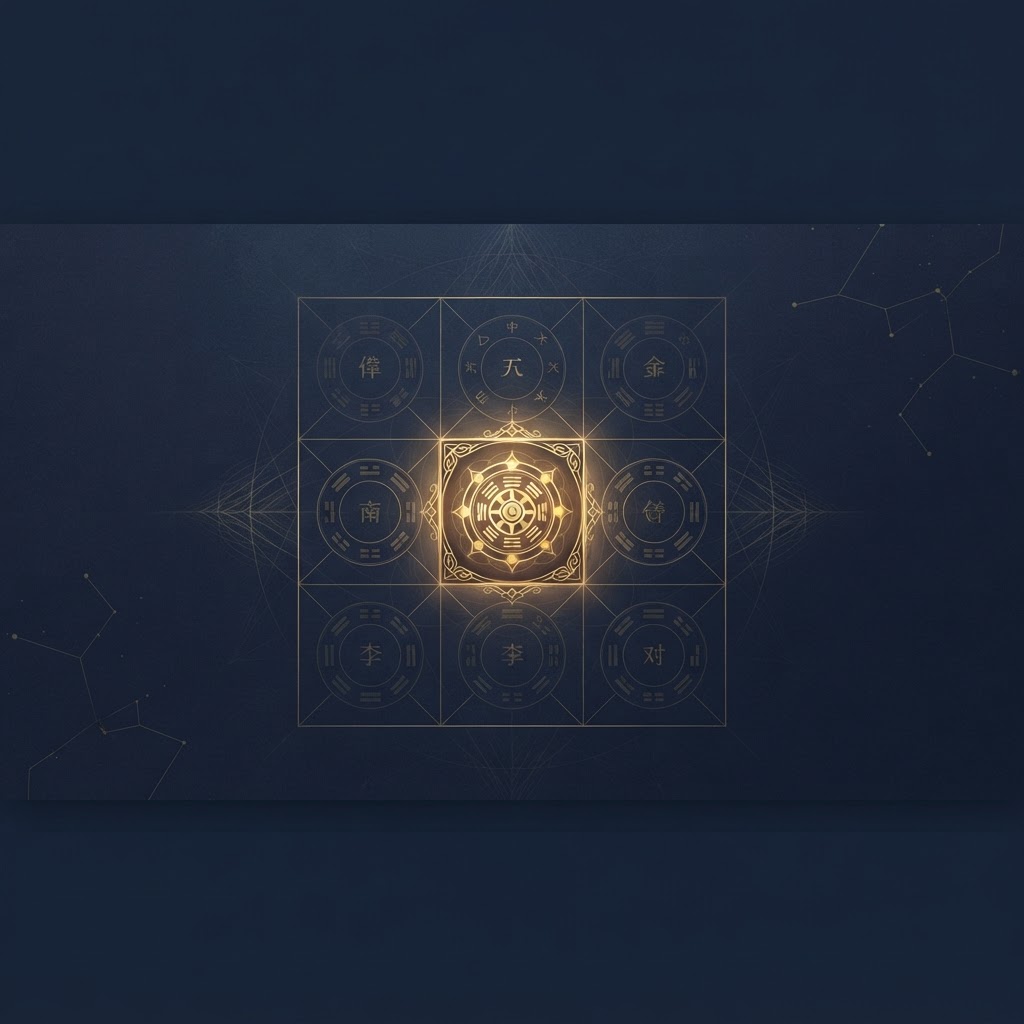
Palace Five is the square at the heart of the Lo Shu arrangement. It is not a compass direction, so a beginner often treats it as an empty gap. That is a mistake. The center is a position of reference, command, and redistribution. It tells us how the chart holds together before we decide whether any single palace looks attractive.
Consider a small company preparing to move offices. The owner wants speed because the lease expires soon, while the operations lead wants time to check access, storage, and staff travel. If Palace Five is involved, I do not announce that the move is lucky or unlucky. I ask what must be coordinated before a responsible decision can stand. The chart may show that the central issue is not the building. It may be the owner’s need to carry every decision personally.
This is where the broader Qi Men Dun Jia framework helps. The nine palaces do not compete for attention. They describe relationships. Palace Five may point toward the seat from which the matter is being managed, while another palace shows the action, person, asset, or destination. The reading becomes useful when those relationships produce a clear next step.
A Palace Without a Direction
I teach this first as a question of responsibility. Who is carrying the matter? What is being coordinated? Which part of the situation is asking to be brought back to a stable point? The answer is not always the person who speaks most loudly. A center reading rewards attention to structure rather than drama.
Consider a small company preparing to move offices. The owner wants speed because the lease expires soon, while the operations lead wants time to check access, storage, and staff travel. If Palace Five is involved, I do not announce that the move is lucky or unlucky. I ask what must be coordinated before a responsible decision can stand. The chart may show that the central issue is not the building. It may be the owner’s need to carry every decision personally.
This is where the broader Qi Men Dun Jia framework helps. The nine palaces do not compete for attention. They describe relationships. Palace Five may point toward the seat from which the matter is being managed, while another palace shows the action, person, asset, or destination. The reading becomes useful when those relationships produce a clear next step.
Reading the Center Before the Edges
The center does not automatically promise success. It can show a sound base, but it can also show a matter that has become too heavy for one person or one team. Its meaning depends on the stems, door, star, deity, and relationship to the useful palace. Read the layers together, then return to the question asked.
Consider a small company preparing to move offices. The owner wants speed because the lease expires soon, while the operations lead wants time to check access, storage, and staff travel. If Palace Five is involved, I do not announce that the move is lucky or unlucky. I ask what must be coordinated before a responsible decision can stand. The chart may show that the central issue is not the building. It may be the owner’s need to carry every decision personally.
This is where the broader Qi Men Dun Jia framework helps. The nine palaces do not compete for attention. They describe relationships. Palace Five may point toward the seat from which the matter is being managed, while another palace shows the action, person, asset, or destination. The reading becomes useful when those relationships produce a clear next step.
The Earth Quality of Palace Five
A chart is a time-specific map, not a personality label. Palace Five is therefore not a permanent description of someone. It describes the central condition at the moment of casting. This distinction keeps the reading practical and prevents the common habit of turning one chart into a prediction about an entire life.
Consider a small company preparing to move offices. The owner wants speed because the lease expires soon, while the operations lead wants time to check access, storage, and staff travel. If Palace Five is involved, I do not announce that the move is lucky or unlucky. I ask what must be coordinated before a responsible decision can stand. The chart may show that the central issue is not the building. It may be the owner’s need to carry every decision personally.
This is where the broader Qi Men Dun Jia framework helps. The nine palaces do not compete for attention. They describe relationships. Palace Five may point toward the seat from which the matter is being managed, while another palace shows the action, person, asset, or destination. The reading becomes useful when those relationships produce a clear next step.
Command Is Not the Same as Control
In a consultation, I write the question in one sentence before interpreting the center. For example: Should the founder accept the proposed partnership this month? That wording gives the central palace a job. It must help us judge authority, coordination, and the burden of commitment, not produce a vague statement about power.
Consider a small company preparing to move offices. The owner wants speed because the lease expires soon, while the operations lead wants time to check access, storage, and staff travel. If Palace Five is involved, I do not announce that the move is lucky or unlucky. I ask what must be coordinated before a responsible decision can stand. The chart may show that the central issue is not the building. It may be the owner’s need to carry every decision personally.
This is where the broader Qi Men Dun Jia framework helps. The nine palaces do not compete for attention. They describe relationships. Palace Five may point toward the seat from which the matter is being managed, while another palace shows the action, person, asset, or destination. The reading becomes useful when those relationships produce a clear next step.
How the Luoshu Holds Its Center
Palace Five is the square at the heart of the Lo Shu arrangement. It is not a compass direction, so a beginner often treats it as an empty gap. That is a mistake. The center is a position of reference, command, and redistribution. It tells us how the chart holds together before we decide whether any single palace looks attractive.
Consider a small company preparing to move offices. The owner wants speed because the lease expires soon, while the operations lead wants time to check access, storage, and staff travel. If Palace Five is involved, I do not announce that the move is lucky or unlucky. I ask what must be coordinated before a responsible decision can stand. The chart may show that the central issue is not the building. It may be the owner’s need to carry every decision personally.
This is where the broader Qi Men Dun Jia framework helps. The nine palaces do not compete for attention. They describe relationships. Palace Five may point toward the seat from which the matter is being managed, while another palace shows the action, person, asset, or destination. The reading becomes useful when those relationships produce a clear next step.
The Five Palace in a Working Chart
I teach this first as a question of responsibility. Who is carrying the matter? What is being coordinated? Which part of the situation is asking to be brought back to a stable point? The answer is not always the person who speaks most loudly. A center reading rewards attention to structure rather than drama.
Consider a small company preparing to move offices. The owner wants speed because the lease expires soon, while the operations lead wants time to check access, storage, and staff travel. If Palace Five is involved, I do not announce that the move is lucky or unlucky. I ask what must be coordinated before a responsible decision can stand. The chart may show that the central issue is not the building. It may be the owner’s need to carry every decision personally.
This is where the broader Qi Men Dun Jia framework helps. The nine palaces do not compete for attention. They describe relationships. Palace Five may point toward the seat from which the matter is being managed, while another palace shows the action, person, asset, or destination. The reading becomes useful when those relationships produce a clear next step.
A Student Brings a Difficult Decision
The center does not automatically promise success. It can show a sound base, but it can also show a matter that has become too heavy for one person or one team. Its meaning depends on the stems, door, star, deity, and relationship to the useful palace. Read the layers together, then return to the question asked.
Consider a small company preparing to move offices. The owner wants speed because the lease expires soon, while the operations lead wants time to check access, storage, and staff travel. If Palace Five is involved, I do not announce that the move is lucky or unlucky. I ask what must be coordinated before a responsible decision can stand. The chart may show that the central issue is not the building. It may be the owner’s need to carry every decision personally.
This is where the broader Qi Men Dun Jia framework helps. The nine palaces do not compete for attention. They describe relationships. Palace Five may point toward the seat from which the matter is being managed, while another palace shows the action, person, asset, or destination. The reading becomes useful when those relationships produce a clear next step.
The Center and the Hour Stem
A chart is a time-specific map, not a personality label. Palace Five is therefore not a permanent description of someone. It describes the central condition at the moment of casting. This distinction keeps the reading practical and prevents the common habit of turning one chart into a prediction about an entire life.
Consider a small company preparing to move offices. The owner wants speed because the lease expires soon, while the operations lead wants time to check access, storage, and staff travel. If Palace Five is involved, I do not announce that the move is lucky or unlucky. I ask what must be coordinated before a responsible decision can stand. The chart may show that the central issue is not the building. It may be the owner’s need to carry every decision personally.
This is where the broader Qi Men Dun Jia framework helps. The nine palaces do not compete for attention. They describe relationships. Palace Five may point toward the seat from which the matter is being managed, while another palace shows the action, person, asset, or destination. The reading becomes useful when those relationships produce a clear next step.
Separating Location from Function
In a consultation, I write the question in one sentence before interpreting the center. For example: Should the founder accept the proposed partnership this month? That wording gives the central palace a job. It must help us judge authority, coordination, and the burden of commitment, not produce a vague statement about power.
Consider a small company preparing to move offices. The owner wants speed because the lease expires soon, while the operations lead wants time to check access, storage, and staff travel. If Palace Five is involved, I do not announce that the move is lucky or unlucky. I ask what must be coordinated before a responsible decision can stand. The chart may show that the central issue is not the building. It may be the owner’s need to carry every decision personally.
This is where the broader Qi Men Dun Jia framework helps. The nine palaces do not compete for attention. They describe relationships. Palace Five may point toward the seat from which the matter is being managed, while another palace shows the action, person, asset, or destination. The reading becomes useful when those relationships produce a clear next step.
The Palace Five Vocabulary
Palace Five is the square at the heart of the Lo Shu arrangement. It is not a compass direction, so a beginner often treats it as an empty gap. That is a mistake. The center is a position of reference, command, and redistribution. It tells us how the chart holds together before we decide whether any single palace looks attractive.
Consider a small company preparing to move offices. The owner wants speed because the lease expires soon, while the operations lead wants time to check access, storage, and staff travel. If Palace Five is involved, I do not announce that the move is lucky or unlucky. I ask what must be coordinated before a responsible decision can stand. The chart may show that the central issue is not the building. It may be the owner’s need to carry every decision personally.
This is where the broader Qi Men Dun Jia framework helps. The nine palaces do not compete for attention. They describe relationships. Palace Five may point toward the seat from which the matter is being managed, while another palace shows the action, person, asset, or destination. The reading becomes useful when those relationships produce a clear next step.
When the Center Is Strong
I teach this first as a question of responsibility. Who is carrying the matter? What is being coordinated? Which part of the situation is asking to be brought back to a stable point? The answer is not always the person who speaks most loudly. A center reading rewards attention to structure rather than drama.
Consider a small company preparing to move offices. The owner wants speed because the lease expires soon, while the operations lead wants time to check access, storage, and staff travel. If Palace Five is involved, I do not announce that the move is lucky or unlucky. I ask what must be coordinated before a responsible decision can stand. The chart may show that the central issue is not the building. It may be the owner’s need to carry every decision personally.
This is where the broader Qi Men Dun Jia framework helps. The nine palaces do not compete for attention. They describe relationships. Palace Five may point toward the seat from which the matter is being managed, while another palace shows the action, person, asset, or destination. The reading becomes useful when those relationships produce a clear next step.
The center does not shout. It tells you what the rest of the chart is standing on.
| Layer | Question at Palace Five | Practical expression |
|---|---|---|
| Earth plate stem | What underlying condition is already present? | Existing duty, resource, or burden |
| Heaven plate stem | What is being imposed or activated? | A decision, pressure, or new influence |
| Door | What kind of action is available? | Opening, pause, repair, conflict, or closure |
When the Center Is Pressured
The center does not automatically promise success. It can show a sound base, but it can also show a matter that has become too heavy for one person or one team. Its meaning depends on the stems, door, star, deity, and relationship to the useful palace. Read the layers together, then return to the question asked.
Consider a small company preparing to move offices. The owner wants speed because the lease expires soon, while the operations lead wants time to check access, storage, and staff travel. If Palace Five is involved, I do not announce that the move is lucky or unlucky. I ask what must be coordinated before a responsible decision can stand. The chart may show that the central issue is not the building. It may be the owner’s need to carry every decision personally.
This is where the broader Qi Men Dun Jia framework helps. The nine palaces do not compete for attention. They describe relationships. Palace Five may point toward the seat from which the matter is being managed, while another palace shows the action, person, asset, or destination. The reading becomes useful when those relationships produce a clear next step.
The Meaning of Stillness Here
A chart is a time-specific map, not a personality label. Palace Five is therefore not a permanent description of someone. It describes the central condition at the moment of casting. This distinction keeps the reading practical and prevents the common habit of turning one chart into a prediction about an entire life.
Consider a small company preparing to move offices. The owner wants speed because the lease expires soon, while the operations lead wants time to check access, storage, and staff travel. If Palace Five is involved, I do not announce that the move is lucky or unlucky. I ask what must be coordinated before a responsible decision can stand. The chart may show that the central issue is not the building. It may be the owner’s need to carry every decision personally.
This is where the broader Qi Men Dun Jia framework helps. The nine palaces do not compete for attention. They describe relationships. Palace Five may point toward the seat from which the matter is being managed, while another palace shows the action, person, asset, or destination. The reading becomes useful when those relationships produce a clear next step.
A Practical Test for Authority
In a consultation, I write the question in one sentence before interpreting the center. For example: Should the founder accept the proposed partnership this month? That wording gives the central palace a job. It must help us judge authority, coordination, and the burden of commitment, not produce a vague statement about power.
Consider a small company preparing to move offices. The owner wants speed because the lease expires soon, while the operations lead wants time to check access, storage, and staff travel. If Palace Five is involved, I do not announce that the move is lucky or unlucky. I ask what must be coordinated before a responsible decision can stand. The chart may show that the central issue is not the building. It may be the owner’s need to carry every decision personally.
This is where the broader Qi Men Dun Jia framework helps. The nine palaces do not compete for attention. They describe relationships. Palace Five may point toward the seat from which the matter is being managed, while another palace shows the action, person, asset, or destination. The reading becomes useful when those relationships produce a clear next step.
The Hidden Jia and Central Responsibility
Palace Five is the square at the heart of the Lo Shu arrangement. It is not a compass direction, so a beginner often treats it as an empty gap. That is a mistake. The center is a position of reference, command, and redistribution. It tells us how the chart holds together before we decide whether any single palace looks attractive.
Consider a small company preparing to move offices. The owner wants speed because the lease expires soon, while the operations lead wants time to check access, storage, and staff travel. If Palace Five is involved, I do not announce that the move is lucky or unlucky. I ask what must be coordinated before a responsible decision can stand. The chart may show that the central issue is not the building. It may be the owner’s need to carry every decision personally.
This is where the broader Qi Men Dun Jia framework helps. The nine palaces do not compete for attention. They describe relationships. Palace Five may point toward the seat from which the matter is being managed, while another palace shows the action, person, asset, or destination. The reading becomes useful when those relationships produce a clear next step.
The Five Palace and the Eight Directions
I teach this first as a question of responsibility. Who is carrying the matter? What is being coordinated? Which part of the situation is asking to be brought back to a stable point? The answer is not always the person who speaks most loudly. A center reading rewards attention to structure rather than drama.
Consider a small company preparing to move offices. The owner wants speed because the lease expires soon, while the operations lead wants time to check access, storage, and staff travel. If Palace Five is involved, I do not announce that the move is lucky or unlucky. I ask what must be coordinated before a responsible decision can stand. The chart may show that the central issue is not the building. It may be the owner’s need to carry every decision personally.
This is where the broader Qi Men Dun Jia framework helps. The nine palaces do not compete for attention. They describe relationships. Palace Five may point toward the seat from which the matter is being managed, while another palace shows the action, person, asset, or destination. The reading becomes useful when those relationships produce a clear next step.
Reading the Earth Plate
The center does not automatically promise success. It can show a sound base, but it can also show a matter that has become too heavy for one person or one team. Its meaning depends on the stems, door, star, deity, and relationship to the useful palace. Read the layers together, then return to the question asked.
Consider a small company preparing to move offices. The owner wants speed because the lease expires soon, while the operations lead wants time to check access, storage, and staff travel. If Palace Five is involved, I do not announce that the move is lucky or unlucky. I ask what must be coordinated before a responsible decision can stand. The chart may show that the central issue is not the building. It may be the owner’s need to carry every decision personally.
This is where the broader Qi Men Dun Jia framework helps. The nine palaces do not compete for attention. They describe relationships. Palace Five may point toward the seat from which the matter is being managed, while another palace shows the action, person, asset, or destination. The reading becomes useful when those relationships produce a clear next step.
Reading the Heaven Plate
A chart is a time-specific map, not a personality label. Palace Five is therefore not a permanent description of someone. It describes the central condition at the moment of casting. This distinction keeps the reading practical and prevents the common habit of turning one chart into a prediction about an entire life.
Consider a small company preparing to move offices. The owner wants speed because the lease expires soon, while the operations lead wants time to check access, storage, and staff travel. If Palace Five is involved, I do not announce that the move is lucky or unlucky. I ask what must be coordinated before a responsible decision can stand. The chart may show that the central issue is not the building. It may be the owner’s need to carry every decision personally.
This is where the broader Qi Men Dun Jia framework helps. The nine palaces do not compete for attention. They describe relationships. Palace Five may point toward the seat from which the matter is being managed, while another palace shows the action, person, asset, or destination. The reading becomes useful when those relationships produce a clear next step.
Doors That Borrow the Center
In a consultation, I write the question in one sentence before interpreting the center. For example: Should the founder accept the proposed partnership this month? That wording gives the central palace a job. It must help us judge authority, coordination, and the burden of commitment, not produce a vague statement about power.
Consider a small company preparing to move offices. The owner wants speed because the lease expires soon, while the operations lead wants time to check access, storage, and staff travel. If Palace Five is involved, I do not announce that the move is lucky or unlucky. I ask what must be coordinated before a responsible decision can stand. The chart may show that the central issue is not the building. It may be the owner’s need to carry every decision personally.
This is where the broader Qi Men Dun Jia framework helps. The nine palaces do not compete for attention. They describe relationships. Palace Five may point toward the seat from which the matter is being managed, while another palace shows the action, person, asset, or destination. The reading becomes useful when those relationships produce a clear next step.
Stars That Gather Weight
Palace Five is the square at the heart of the Lo Shu arrangement. It is not a compass direction, so a beginner often treats it as an empty gap. That is a mistake. The center is a position of reference, command, and redistribution. It tells us how the chart holds together before we decide whether any single palace looks attractive.
Consider a small company preparing to move offices. The owner wants speed because the lease expires soon, while the operations lead wants time to check access, storage, and staff travel. If Palace Five is involved, I do not announce that the move is lucky or unlucky. I ask what must be coordinated before a responsible decision can stand. The chart may show that the central issue is not the building. It may be the owner’s need to carry every decision personally.
This is where the broader Qi Men Dun Jia framework helps. The nine palaces do not compete for attention. They describe relationships. Palace Five may point toward the seat from which the matter is being managed, while another palace shows the action, person, asset, or destination. The reading becomes useful when those relationships produce a clear next step.
Deities Around the Command Seat
I teach this first as a question of responsibility. Who is carrying the matter? What is being coordinated? Which part of the situation is asking to be brought back to a stable point? The answer is not always the person who speaks most loudly. A center reading rewards attention to structure rather than drama.
Consider a small company preparing to move offices. The owner wants speed because the lease expires soon, while the operations lead wants time to check access, storage, and staff travel. If Palace Five is involved, I do not announce that the move is lucky or unlucky. I ask what must be coordinated before a responsible decision can stand. The chart may show that the central issue is not the building. It may be the owner’s need to carry every decision personally.
This is where the broader Qi Men Dun Jia framework helps. The nine palaces do not compete for attention. They describe relationships. Palace Five may point toward the seat from which the matter is being managed, while another palace shows the action, person, asset, or destination. The reading becomes useful when those relationships produce a clear next step.
The Center in Yang Dun
The center does not automatically promise success. It can show a sound base, but it can also show a matter that has become too heavy for one person or one team. Its meaning depends on the stems, door, star, deity, and relationship to the useful palace. Read the layers together, then return to the question asked.
Consider a small company preparing to move offices. The owner wants speed because the lease expires soon, while the operations lead wants time to check access, storage, and staff travel. If Palace Five is involved, I do not announce that the move is lucky or unlucky. I ask what must be coordinated before a responsible decision can stand. The chart may show that the central issue is not the building. It may be the owner’s need to carry every decision personally.
This is where the broader Qi Men Dun Jia framework helps. The nine palaces do not compete for attention. They describe relationships. Palace Five may point toward the seat from which the matter is being managed, while another palace shows the action, person, asset, or destination. The reading becomes useful when those relationships produce a clear next step.
The Center in Yin Dun
A chart is a time-specific map, not a personality label. Palace Five is therefore not a permanent description of someone. It describes the central condition at the moment of casting. This distinction keeps the reading practical and prevents the common habit of turning one chart into a prediction about an entire life.
Consider a small company preparing to move offices. The owner wants speed because the lease expires soon, while the operations lead wants time to check access, storage, and staff travel. If Palace Five is involved, I do not announce that the move is lucky or unlucky. I ask what must be coordinated before a responsible decision can stand. The chart may show that the central issue is not the building. It may be the owner’s need to carry every decision personally.
This is where the broader Qi Men Dun Jia framework helps. The nine palaces do not compete for attention. They describe relationships. Palace Five may point toward the seat from which the matter is being managed, while another palace shows the action, person, asset, or destination. The reading becomes useful when those relationships produce a clear next step.
A Full Chart Walkthrough
In a consultation, I write the question in one sentence before interpreting the center. For example: Should the founder accept the proposed partnership this month? That wording gives the central palace a job. It must help us judge authority, coordination, and the burden of commitment, not produce a vague statement about power.
Consider a small company preparing to move offices. The owner wants speed because the lease expires soon, while the operations lead wants time to check access, storage, and staff travel. If Palace Five is involved, I do not announce that the move is lucky or unlucky. I ask what must be coordinated before a responsible decision can stand. The chart may show that the central issue is not the building. It may be the owner’s need to carry every decision personally.
This is where the broader Qi Men Dun Jia framework helps. The nine palaces do not compete for attention. They describe relationships. Palace Five may point toward the seat from which the matter is being managed, while another palace shows the action, person, asset, or destination. The reading becomes useful when those relationships produce a clear next step.
Three Layers That Must Not Be Confused
One of the most useful disciplines is to keep three statements separate. The palace tells us where a condition sits in the nine-square map. The door tells us what kind of activity is available. The star tells us the quality or mode of the matter, while the deity adds the social or psychological atmosphere. These statements may support one another, but they are not synonyms.
Suppose Palace Five carries View Door. That does not mean the center is simply famous. View Door concerns perception, publicity, fame, visibility, and being thrust into the spotlight. In a central position, the question may involve who must present the decision, whose reputation carries the burden, or why a private matter is becoming public. The correct advice may be to prepare a clean explanation rather than seek applause.
If the same palace carries Rest Door, recovery, healing, relaxation, family matters, and harmonious communication become more relevant. A central Rest Door can say that the whole matter needs a pause before a public move. It does not mean that nothing can happen. It means the quality of the next action matters more than speed.
The center does not shout. It tells you what the rest of the chart is standing on.
| Layer | Question at Palace Five | Practical expression |
|---|---|---|
| Earth plate stem | What underlying condition is already present? | Existing duty, resource, or burden |
| Heaven plate stem | What is being imposed or activated? | A decision, pressure, or new influence |
| Door | What kind of action is available? | Opening, pause, repair, conflict, or closure |
A Hiring Decision Under Pressure
Palace Five is the square at the heart of the Lo Shu arrangement. It is not a compass direction, so a beginner often treats it as an empty gap. That is a mistake. The center is a position of reference, command, and redistribution. It tells us how the chart holds together before we decide whether any single palace looks attractive.
Consider a small company preparing to move offices. The owner wants speed because the lease expires soon, while the operations lead wants time to check access, storage, and staff travel. If Palace Five is involved, I do not announce that the move is lucky or unlucky. I ask what must be coordinated before a responsible decision can stand. The chart may show that the central issue is not the building. It may be the owner’s need to carry every decision personally.
This is where the broader Qi Men Dun Jia framework helps. The nine palaces do not compete for attention. They describe relationships. Palace Five may point toward the seat from which the matter is being managed, while another palace shows the action, person, asset, or destination. The reading becomes useful when those relationships produce a clear next step.
A Property Question With No Simple Answer
I teach this first as a question of responsibility. Who is carrying the matter? What is being coordinated? Which part of the situation is asking to be brought back to a stable point? The answer is not always the person who speaks most loudly. A center reading rewards attention to structure rather than drama.
Consider a small company preparing to move offices. The owner wants speed because the lease expires soon, while the operations lead wants time to check access, storage, and staff travel. If Palace Five is involved, I do not announce that the move is lucky or unlucky. I ask what must be coordinated before a responsible decision can stand. The chart may show that the central issue is not the building. It may be the owner’s need to carry every decision personally.
This is where the broader Qi Men Dun Jia framework helps. The nine palaces do not compete for attention. They describe relationships. Palace Five may point toward the seat from which the matter is being managed, while another palace shows the action, person, asset, or destination. The reading becomes useful when those relationships produce a clear next step.
A Health Question Requires Restraint
The center does not automatically promise success. It can show a sound base, but it can also show a matter that has become too heavy for one person or one team. Its meaning depends on the stems, door, star, deity, and relationship to the useful palace. Read the layers together, then return to the question asked.
Consider a small company preparing to move offices. The owner wants speed because the lease expires soon, while the operations lead wants time to check access, storage, and staff travel. If Palace Five is involved, I do not announce that the move is lucky or unlucky. I ask what must be coordinated before a responsible decision can stand. The chart may show that the central issue is not the building. It may be the owner’s need to carry every decision personally.
This is where the broader Qi Men Dun Jia framework helps. The nine palaces do not compete for attention. They describe relationships. Palace Five may point toward the seat from which the matter is being managed, while another palace shows the action, person, asset, or destination. The reading becomes useful when those relationships produce a clear next step.
Timing the Next Responsible Move
A chart is a time-specific map, not a personality label. Palace Five is therefore not a permanent description of someone. It describes the central condition at the moment of casting. This distinction keeps the reading practical and prevents the common habit of turning one chart into a prediction about an entire life.
Consider a small company preparing to move offices. The owner wants speed because the lease expires soon, while the operations lead wants time to check access, storage, and staff travel. If Palace Five is involved, I do not announce that the move is lucky or unlucky. I ask what must be coordinated before a responsible decision can stand. The chart may show that the central issue is not the building. It may be the owner’s need to carry every decision personally.
This is where the broader Qi Men Dun Jia framework helps. The nine palaces do not compete for attention. They describe relationships. Palace Five may point toward the seat from which the matter is being managed, while another palace shows the action, person, asset, or destination. The reading becomes useful when those relationships produce a clear next step.
The Difference Between Delay and Preparation
In a consultation, I write the question in one sentence before interpreting the center. For example: Should the founder accept the proposed partnership this month? That wording gives the central palace a job. It must help us judge authority, coordination, and the burden of commitment, not produce a vague statement about power.
Consider a small company preparing to move offices. The owner wants speed because the lease expires soon, while the operations lead wants time to check access, storage, and staff travel. If Palace Five is involved, I do not announce that the move is lucky or unlucky. I ask what must be coordinated before a responsible decision can stand. The chart may show that the central issue is not the building. It may be the owner’s need to carry every decision personally.
This is where the broader Qi Men Dun Jia framework helps. The nine palaces do not compete for attention. They describe relationships. Palace Five may point toward the seat from which the matter is being managed, while another palace shows the action, person, asset, or destination. The reading becomes useful when those relationships produce a clear next step.
What a Weak Center Actually Shows
Palace Five is the square at the heart of the Lo Shu arrangement. It is not a compass direction, so a beginner often treats it as an empty gap. That is a mistake. The center is a position of reference, command, and redistribution. It tells us how the chart holds together before we decide whether any single palace looks attractive.
Consider a small company preparing to move offices. The owner wants speed because the lease expires soon, while the operations lead wants time to check access, storage, and staff travel. If Palace Five is involved, I do not announce that the move is lucky or unlucky. I ask what must be coordinated before a responsible decision can stand. The chart may show that the central issue is not the building. It may be the owner’s need to carry every decision personally.
This is where the broader Qi Men Dun Jia framework helps. The nine palaces do not compete for attention. They describe relationships. Palace Five may point toward the seat from which the matter is being managed, while another palace shows the action, person, asset, or destination. The reading becomes useful when those relationships produce a clear next step.
What an Overloaded Center Reveals
I teach this first as a question of responsibility. Who is carrying the matter? What is being coordinated? Which part of the situation is asking to be brought back to a stable point? The answer is not always the person who speaks most loudly. A center reading rewards attention to structure rather than drama.
Consider a small company preparing to move offices. The owner wants speed because the lease expires soon, while the operations lead wants time to check access, storage, and staff travel. If Palace Five is involved, I do not announce that the move is lucky or unlucky. I ask what must be coordinated before a responsible decision can stand. The chart may show that the central issue is not the building. It may be the owner’s need to carry every decision personally.
This is where the broader Qi Men Dun Jia framework helps. The nine palaces do not compete for attention. They describe relationships. Palace Five may point toward the seat from which the matter is being managed, while another palace shows the action, person, asset, or destination. The reading becomes useful when those relationships produce a clear next step.
Three Errors I Correct in Class
The center does not automatically promise success. It can show a sound base, but it can also show a matter that has become too heavy for one person or one team. Its meaning depends on the stems, door, star, deity, and relationship to the useful palace. Read the layers together, then return to the question asked.
Consider a small company preparing to move offices. The owner wants speed because the lease expires soon, while the operations lead wants time to check access, storage, and staff travel. If Palace Five is involved, I do not announce that the move is lucky or unlucky. I ask what must be coordinated before a responsible decision can stand. The chart may show that the central issue is not the building. It may be the owner’s need to carry every decision personally.
This is where the broader Qi Men Dun Jia framework helps. The nine palaces do not compete for attention. They describe relationships. Palace Five may point toward the seat from which the matter is being managed, while another palace shows the action, person, asset, or destination. The reading becomes useful when those relationships produce a clear next step.
A Checklist for Consultation Notes
A chart is a time-specific map, not a personality label. Palace Five is therefore not a permanent description of someone. It describes the central condition at the moment of casting. This distinction keeps the reading practical and prevents the common habit of turning one chart into a prediction about an entire life.
Consider a small company preparing to move offices. The owner wants speed because the lease expires soon, while the operations lead wants time to check access, storage, and staff travel. If Palace Five is involved, I do not announce that the move is lucky or unlucky. I ask what must be coordinated before a responsible decision can stand. The chart may show that the central issue is not the building. It may be the owner’s need to carry every decision personally.
This is where the broader Qi Men Dun Jia framework helps. The nine palaces do not compete for attention. They describe relationships. Palace Five may point toward the seat from which the matter is being managed, while another palace shows the action, person, asset, or destination. The reading becomes useful when those relationships produce a clear next step.
Questions Students Ask About Palace Five
In a consultation, I write the question in one sentence before interpreting the center. For example: Should the founder accept the proposed partnership this month? That wording gives the central palace a job. It must help us judge authority, coordination, and the burden of commitment, not produce a vague statement about power.
Consider a small company preparing to move offices. The owner wants speed because the lease expires soon, while the operations lead wants time to check access, storage, and staff travel. If Palace Five is involved, I do not announce that the move is lucky or unlucky. I ask what must be coordinated before a responsible decision can stand. The chart may show that the central issue is not the building. It may be the owner’s need to carry every decision personally.
This is where the broader Qi Men Dun Jia framework helps. The nine palaces do not compete for attention. They describe relationships. Palace Five may point toward the seat from which the matter is being managed, while another palace shows the action, person, asset, or destination. The reading becomes useful when those relationships produce a clear next step.
How to Explain the Center to a Client
Palace Five is the square at the heart of the Lo Shu arrangement. It is not a compass direction, so a beginner often treats it as an empty gap. That is a mistake. The center is a position of reference, command, and redistribution. It tells us how the chart holds together before we decide whether any single palace looks attractive.
Consider a small company preparing to move offices. The owner wants speed because the lease expires soon, while the operations lead wants time to check access, storage, and staff travel. If Palace Five is involved, I do not announce that the move is lucky or unlucky. I ask what must be coordinated before a responsible decision can stand. The chart may show that the central issue is not the building. It may be the owner’s need to carry every decision personally.
This is where the broader Qi Men Dun Jia framework helps. The nine palaces do not compete for attention. They describe relationships. Palace Five may point toward the seat from which the matter is being managed, while another palace shows the action, person, asset, or destination. The reading becomes useful when those relationships produce a clear next step.
The Limits of a Central Sign
I teach this first as a question of responsibility. Who is carrying the matter? What is being coordinated? Which part of the situation is asking to be brought back to a stable point? The answer is not always the person who speaks most loudly. A center reading rewards attention to structure rather than drama.
Consider a small company preparing to move offices. The owner wants speed because the lease expires soon, while the operations lead wants time to check access, storage, and staff travel. If Palace Five is involved, I do not announce that the move is lucky or unlucky. I ask what must be coordinated before a responsible decision can stand. The chart may show that the central issue is not the building. It may be the owner’s need to carry every decision personally.
This is where the broader Qi Men Dun Jia framework helps. The nine palaces do not compete for attention. They describe relationships. Palace Five may point toward the seat from which the matter is being managed, while another palace shows the action, person, asset, or destination. The reading becomes useful when those relationships produce a clear next step.
Practice Exercise: Nine Squares
The center does not automatically promise success. It can show a sound base, but it can also show a matter that has become too heavy for one person or one team. Its meaning depends on the stems, door, star, deity, and relationship to the useful palace. Read the layers together, then return to the question asked.
Consider a small company preparing to move offices. The owner wants speed because the lease expires soon, while the operations lead wants time to check access, storage, and staff travel. If Palace Five is involved, I do not announce that the move is lucky or unlucky. I ask what must be coordinated before a responsible decision can stand. The chart may show that the central issue is not the building. It may be the owner’s need to carry every decision personally.
This is where the broader Qi Men Dun Jia framework helps. The nine palaces do not compete for attention. They describe relationships. Palace Five may point toward the seat from which the matter is being managed, while another palace shows the action, person, asset, or destination. The reading becomes useful when those relationships produce a clear next step.
Practice Exercise: Compare Two Hours
A chart is a time-specific map, not a personality label. Palace Five is therefore not a permanent description of someone. It describes the central condition at the moment of casting. This distinction keeps the reading practical and prevents the common habit of turning one chart into a prediction about an entire life.
Consider a small company preparing to move offices. The owner wants speed because the lease expires soon, while the operations lead wants time to check access, storage, and staff travel. If Palace Five is involved, I do not announce that the move is lucky or unlucky. I ask what must be coordinated before a responsible decision can stand. The chart may show that the central issue is not the building. It may be the owner’s need to carry every decision personally.
This is where the broader Qi Men Dun Jia framework helps. The nine palaces do not compete for attention. They describe relationships. Palace Five may point toward the seat from which the matter is being managed, while another palace shows the action, person, asset, or destination. The reading becomes useful when those relationships produce a clear next step.
A Calm Way to Give the Result
In a consultation, I write the question in one sentence before interpreting the center. For example: Should the founder accept the proposed partnership this month? That wording gives the central palace a job. It must help us judge authority, coordination, and the burden of commitment, not produce a vague statement about power.
Consider a small company preparing to move offices. The owner wants speed because the lease expires soon, while the operations lead wants time to check access, storage, and staff travel. If Palace Five is involved, I do not announce that the move is lucky or unlucky. I ask what must be coordinated before a responsible decision can stand. The chart may show that the central issue is not the building. It may be the owner’s need to carry every decision personally.
This is where the broader Qi Men Dun Jia framework helps. The nine palaces do not compete for attention. They describe relationships. Palace Five may point toward the seat from which the matter is being managed, while another palace shows the action, person, asset, or destination. The reading becomes useful when those relationships produce a clear next step.
The Final Discipline of the Center
Palace Five is the square at the heart of the Lo Shu arrangement. It is not a compass direction, so a beginner often treats it as an empty gap. That is a mistake. The center is a position of reference, command, and redistribution. It tells us how the chart holds together before we decide whether any single palace looks attractive.
Consider a small company preparing to move offices. The owner wants speed because the lease expires soon, while the operations lead wants time to check access, storage, and staff travel. If Palace Five is involved, I do not announce that the move is lucky or unlucky. I ask what must be coordinated before a responsible decision can stand. The chart may show that the central issue is not the building. It may be the owner’s need to carry every decision personally.
This is where the broader Qi Men Dun Jia framework helps. The nine palaces do not compete for attention. They describe relationships. Palace Five may point toward the seat from which the matter is being managed, while another palace shows the action, person, asset, or destination. The reading becomes useful when those relationships produce a clear next step.
| Observation | Weak interpretation | Stronger interpretation |
|---|---|---|
| Heavy stem in center | Bad luck | A duty or pressure that needs a named owner |
| Supportive door | Guaranteed success | A workable action if timing and relationships agree |
| Contradictory layers | The chart is useless | The matter needs sequencing, limits, or a narrower question |
Closing the Chart Without Overclaiming
Palace Five teaches a modest conclusion. A reading is strongest when it shows who must coordinate what, by which action, and within which time. It is weakest when it turns a central symbol into a dramatic verdict. I would rather give a client one useful instruction than five impressive predictions.
Before you finish, return to the original question and write the answer in plain language. If the center indicates preparation, name the preparation. If it indicates a burden, name the burden and its owner. If it indicates visibility, name the audience and the message. This is how technical analysis becomes responsible advice.
For a fuller foundation, revisit the main Qi Men Dun Jia guide, then compare this center reading with the articles on the Nine Palaces and chart construction. Palace Five becomes clearer when it is read as part of the complete chart rather than isolated as a lucky square.
Four Questions for a Central Decision
First, ask what must remain stable while the decision develops. Stability does not mean refusing change. It means knowing which promise, resource, relationship, or standard cannot be abandoned merely to create movement. In a hiring decision, it may be the role’s actual scope. In a property decision, it may be the financing limit. In a family matter, it may be the need to preserve a respectful line of communication.
Second, ask who has the authority to make the next move. Palace Five can expose a gap between responsibility and authority. Someone may be expected to deliver the result but denied the information or permission required to act. That is not a mysterious omen. It is a management problem, and the reading should name it plainly.
Third, ask whether the action belongs in the center or should be delegated to a directional palace. The center coordinates. It need not perform every task. A founder who insists on approving each invoice may believe that central control protects quality. In reality, the practice can turn a sound center into a bottleneck. The chart may support a transfer of responsibility rather than another meeting.
Fourth, ask what evidence would change the advice. This question protects against overconfidence. If a contract is central, the missing evidence may be a liability clause. If health is central, it may be a professional diagnosis. If travel is central, it may be a route, weather, or timing issue. Qi Men Dun Jia can help organise attention, but it should not replace ordinary verification.
A note on the center and professional judgment
There are questions I will not answer from symbolism alone. A chart cannot approve a medical treatment, certify a building, replace legal advice, or guarantee a financial return. It can help a person frame timing and priorities. It can show where a decision is carrying too much pressure. Good practice becomes more, not less, careful when the stakes rise.
This restraint is not a weakness of the method. It is part of using a method honestly. In classes, I ask students to write two columns. The first column contains what the chart suggests. The second contains what must still be checked in the real situation. Palace Five often improves the second column because it reveals the responsibility that had been left vague.
When the two columns agree, the advice becomes more confident. When they disagree, slow down. A central sign that looks strong may still sit over incomplete facts. A difficult sign may simply be describing the cost of a necessary action. The task is not to force the chart to deliver comfort. The task is to make the decision more conscious.
Keeping the Center Useful in Daily Work
A practical way to use Palace Five is to turn its message into a short operating rule. If the chart shows too many competing duties, assign one decision owner and one review date. If the chart shows a need for recovery, protect a quiet interval and do not fill it with symbolic activity. If the chart shows public exposure, prepare the explanation before making the announcement. The rule should be observable. Someone should be able to tell whether it was followed.
Do the same with a team. Ask each person to state the part of the matter they own, the information they need, and the point at which they will escalate. This simple exercise often reveals why a central issue has felt difficult. People were not necessarily unwilling. They were working from different definitions of completion. A chart can start the conversation, but the agreement must be made in ordinary language.
Over time, keep a record of the question, the chart time, the central configuration, the advice, and the later result. Do not record only successes. Failed calls teach more about the limits of an interpretation. After several cases, patterns become easier to evaluate. You may discover that you were reading a central pressure as external opposition, or treating a coordination delay as a negative outcome. A notebook corrects memory's tendency to keep only dramatic examples.
That is the mature use of the center. It brings the matter back to a responsible point, gives weight to what must be carried, and prevents a reader from confusing symbolic order with certainty. When the decision is finally made, Palace Five has done its work if the people involved understand the structure, the evidence, and the next move.
That is enough structure for a sound consultation and a responsible decision.