
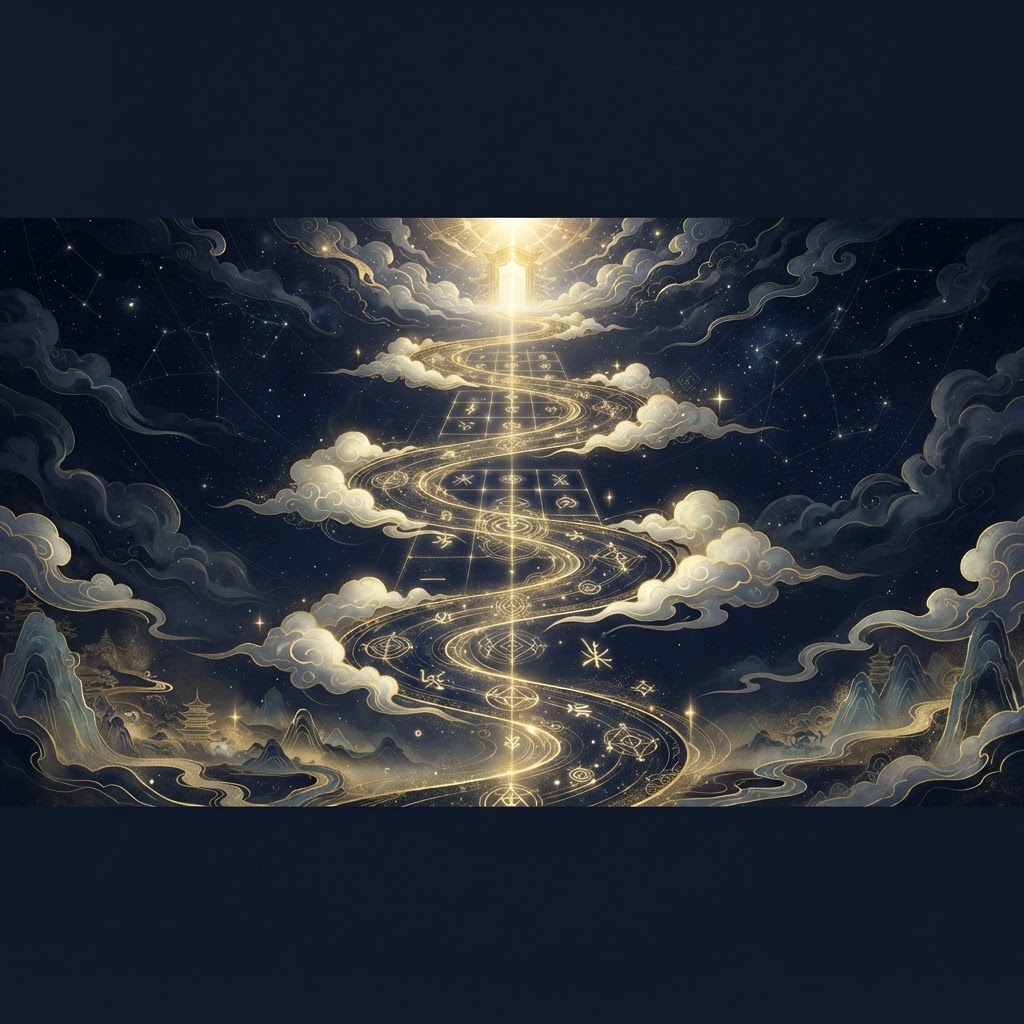
A student once asked me why a chart that looked promising still required restraint. The answer was Jiu Tian. Nine Heaven is associated with height, reach, visibility, expansion, and movement into a larger field. Those qualities are useful, but they are not a guarantee. A kite can rise because the wind supports it, and it can fall because its string was cut. A good reading asks both questions.
Jiu Tian is not simply a lucky symbol. It describes altitude. The matter has room to rise, the people involved may think broadly, and decisions may travel farther than expected. That can support a launch, a negotiation, a public appearance, or a strategic move. It can also expose weak preparation at a much greater scale.
In my consultations, people often want a chart to say yes or no. Jiu Tian rarely speaks that simply. It says the situation is capable of widening. Whether widening becomes progress, publicity, overreach, or a costly loss of control depends on the palace, door, star, stems, host, guest, and timing.
Three coordinates before the ascent
A deity is the atmospheric layer of a Qi Men Dun Jia chart. It does not replace the door or the stems. It tells us how the situation feels and where attention tends to move. Jiu Tian raises the gaze. It favours broad plans, external audiences, senior platforms, long distance, aviation, technology, and matters that require courage to leave a familiar boundary. I use it as a directional clue, never as a standalone verdict.
Jiu means nine and Tian means heaven. The name points to the highest, most expansive image in the deity set. Traditional imagery can be valuable if it remains connected to observable decisions. Height may mean a larger market, a higher office, a public stage, or a plan with several layers. It may also mean distance from ground facts. The practitioner must translate the image into actions that can be checked.
The chart contains the earth plate stems, heaven plate stems, eight doors, nine stars, and eight deities. Jiu Tian belongs to the deity layer. I begin with its position, then compare it with the palace element and the other four layers. A Nine Heaven deity above the Open Door is different from Nine Heaven above the Rest Door. The first may support a visible initiative. The second may describe recovery that needs space and perspective.
| Layer | Question | Practical evidence |
|---|---|---|
| Deity | How far does the matter reach? | Audience, distance, scale |
| Palace | What environment carries it? | Element, direction, sector |
| Door | What action is available? | Opening, visibility, pause or cut |
| Host and guest | Who receives support? | Strength, control and timing |
Height has a geography
The nine-palace grid as a map of reach
The Luoshu arrangement is 4-9-2 across the top, 3-5-7 in the middle, and 8-1-6 below. Palace 1 is north Water, Palace 8 is northeast Earth, Palace 3 is east Wood, Palace 4 is southeast Wood, Palace 9 is south Fire, Palace 2 is southwest Earth, Palace 7 is west Metal, Palace 6 is northwest Metal, and Palace 5 is the centre. Jiu Tian changes its expression as it enters each environment.
Palace 9 and the public blaze
When Jiu Tian occupies Palace 9, height and visibility meet Fire. This can describe publicity, recognition, broadcasting, teaching, presentation, and a strong desire to be seen. It is excellent for showing a finished result when the material is ready. It is risky when the person wants attention before the substance can carry it. I ask what will remain after the applause ends.
Palace 6 and authority above the room
Palace 6 belongs to northwest Metal and carries the image of Heaven, authority, leadership, and senior structures. Jiu Tian here can support dealing with directors, institutions, regulators, or a large organisation. It may also reveal a person who assumes that status alone will solve the matter. The remedy is evidence, clear reporting, and respect for the chain of responsibility.
Palace 7 and sharp public language
Palace 7 is west Metal and is associated with speech, joy, exchange, and completion. With Jiu Tian, words can travel. A presentation, campaign, negotiation, or public statement may reach more people than planned. That reach is useful only if the language is precise. A careless sentence can also travel quickly, so editing is part of the reading, not an afterthought.
Palace 1 and the long arc
In Palace 1, Water gives Nine Heaven a travelling quality. The issue may involve distance, research, online work, shipping, or a plan that moves through several stages. It can be a useful placement for strategy and quiet preparation. Do not mistake movement for completion. Water carries a message forward, but the destination still requires a workable route.
Palace 3 and the first push
Palace 3 is east Wood, a place of growth, initiative, sound, and family movement. Nine Heaven here can describe an energetic launch or an idea that wants immediate growth. It is helpful when a team needs courage. It becomes reckless when speed replaces sequencing. I ask the client to identify the first small action that proves the larger plan has roots.
Palace 4 and networks that spread
Palace 4 is southeast Wood and often brings communication, wind, learning, wealth, and flexible relationships into the picture. Nine Heaven here can enlarge a network or send information across borders. The risk is diffusion. Too many channels can create a lot of motion and very little agreement. A written brief, named owner, and review date keep the wind from scattering the work.
Palace 8 and the mountain test
Palace 8 is northeast Earth, the mountain palace. Nine Heaven in this position creates a tension between elevation and stillness. The ambition may be large, but the next correct move may be to stop, study, and build capacity. This is a useful combination for training, governance, property planning, and disciplined preparation. Expansion begins with a stable base.
Palace 2 and growth that must feed people
Palace 2 is southwest Earth and relates to support, care, land, and patient accumulation. Nine Heaven here can expand a family enterprise, service network, or long-term asset plan. The chart warns against growing faster than the people and systems that carry the growth. A large promise is only healthy if staffing, cash flow, and care arrangements can sustain it.
Palace 5 and command at the centre
Palace 5 is the centre and Earth. When Jiu Tian appears there, the question becomes who is holding the centre while the plan expands. The chart may show a central decision, a transition in leadership, or a situation where every department waits for one person. I prefer a clear command structure to heroic improvisation. The centre should coordinate, not suffocate.
A high position is useful only when the person standing there can still see the ground.
| Palace | Element and direction | Useful question |
|---|---|---|
| 1 | Water, north | What route carries the plan? |
| 8 | Earth, northeast | What must be built before movement? |
| 9 | Fire, south | What will the audience see? |
| 6 | Metal, northwest | Who holds authority? |
| 5 | Earth, centre | Who coordinates the whole matter? |
The door decides how the reach behaves
A door changes the altitude
The door describes what can be done. Jiu Tian describes the atmosphere and reach. Open Door with Nine Heaven often supports a launch, access, or an important introduction. View Door can increase public visibility. Rest Door may indicate strategic retreat with a wider perspective. Death Door can show a decisive exit from an old level. The combination matters more than either label alone.
Nine Heaven with the Open Door
This is one of the clearest combinations for entering a larger arena. It can support a new market, a senior meeting, a public opening, or an application for access. I still check whether the host has support and whether the opponent controls the relevant gatekeeper. The advice is to move through the open channel, not to force a locked one.
Nine Heaven with the View Door
View Door concerns perception, publicity, fame, visibility, and being thrust into the spotlight. Nine Heaven increases the size of the audience. That is excellent for a prepared message, a demonstration, or a launch with strong proof. It is poor for hiding a defect. Before using the date, rehearse questions that a larger audience will ask.
Nine Heaven with the Rest Door
Rest Door concerns recovery, healing, relaxation, family matters, and harmonious communication. With Nine Heaven, rest may mean stepping back far enough to see the system. It can support a retreat, a planning session, or a conversation that needs emotional space. It does not automatically mean doing nothing. Sometimes the highest move is to stop reacting.
Nine Heaven with the Life Door
Life Door is associated with growth, health, new beginnings, long-term asset accumulation, and sustainable profit. Nine Heaven can widen the growth curve. The condition is sustainability. If revenue rises while the delivery system collapses, the chart has been read as permission rather than information. Build the next layer before promising the next scale.
Nine Heaven with the Obstruct Door
Obstruct Door blocks, protects, delays, or keeps secrets hidden. Nine Heaven above it can describe a large plan that is not yet ready for disclosure. It can also show an impressive vision behind a gate that still needs approval. I do not advise forcing the obstruction. Identify what the barrier protects, then decide whether a smaller legitimate route exists.
Nine Heaven with the Dispute Door
Dispute Door concerns verbal combat, panic, litigation, and legal disputes. Nine Heaven amplifies the audience and the consequences. A public argument can become a permanent record. If action is necessary, use precise language, a proper forum, and documented authority. Do not confuse a louder response with a stronger legal position.
Nine Heaven with the Injury Door
Injury Door concerns physical injury, loss, conflict, and managing contingencies. Nine Heaven can enlarge the cost of a small mistake. In a travel or operational question, I look for safety margins, insurance, backup routes, and the person responsible for stopping the action. Boldness has value only when the downside is bounded.
Nine Heaven with the Death Door
Death Door indicates radical transformation, decisive endings, or rigid deadlocks in business and health. Nine Heaven can lift an ending into a new chapter, but it can also make a dramatic cut highly visible. This combination can support closing a failing structure cleanly. It is not a licence for theatrical destruction. Name what must end and what must be protected.
A nine-part contrast in the upper register
The nine stars describe another kind of quality. Tian Fu, the Advisor Star, can make the expansion methodical. Tian Ying, the Fearless Star, can make it visible and hot. Tian Xin, the Diplomat Star, favours precision and clean edges. Tian Peng, the Bandit Star, may add appetite and risk. Tian Rui, the Problem Star, asks whether the system has an unresolved fault. Jiu Tian does not erase these differences.
| Door | Jiu Tian expression | Safeguard |
|---|---|---|
| Open Door | New access and a larger initiative | Confirm the gatekeeper and first milestone |
| View Door | Publicity and attention | Edit claims and prepare responses |
| Rest Door | Distance, recovery and perspective | Protect quiet time from interruption |
| Obstruct Door | A large plan behind a necessary gate | Learn what the barrier protects |
| Dispute Door | A dispute that may travel widely | Use documented, precise language |
Stars, stems, and the load beneath the image
Comparing the nine qualities before action
The nine stars describe another kind of quality. Tian Fu, the Advisor Star, can make the expansion methodical. Tian Ying, the Fearless Star, can make it visible and hot. Tian Xin, the Diplomat Star, favours precision and clean edges. Tian Peng, the Bandit Star, may add appetite and risk. Tian Rui, the Problem Star, asks whether the system has an unresolved fault. Jiu Tian does not erase these differences.
Stems reveal what carries the height
The ten heavenly stems are Jia, Yi, Bing, Ding, Wu, Ji, Geng, Xin, Ren, and Gui. Jia is hidden in Qi Men Dun Jia. The six Jia pairings hide under Wu, Ji, Geng, Xin, Ren, and Gui in the established sequence. With Jiu Tian, stems tell me what is being lifted and what may be exposed. Geng can represent the Chief Opponent, while Yi may show flexible craft. Read the stem as a material clue, not a moral label.
The value star and the hour
The value star, Zhi Fu, is the lead stem of the current sixty-hour block. The heaven plate rotates so that stem sits at the palace of the hour stem. The value door, Zhi Shi, follows the hour branch by its own rule. Deities start from the value star position and step according to the dun direction. These mechanics matter because Jiu Tian is not floating outside the chart. Its location comes from a timed construction.
The worked date and what Jiu Tian adds
Use the project example consistently: April 14, 2026, at 2pm Singapore is Clear and Bright, Yang Dun, day pillar Wu-Wu, with Jia-Yin as Fu Tou on April 10. Yin branch selects middle yuan, and Clear and Bright carries the yang trio 4, 1, 7, so the chart is Yang Dun 1 Ju. If Jiu Tian appears in a high-reaching palace on that chart, I still read the exact door and stems before advising a launch.
A business expansion consultation
Imagine a founder asking whether to take a regional contract. Jiu Tian sits with Open Door in Palace 4, while the host has support from a useful stem and the guest is weakened. I would not say, 'The contract is guaranteed.' I would say the chart supports outreach and wider circulation. Then I would check delivery capacity, payment terms, local law, and the first milestone. The chart selects the quality of the move; the contract protects the person making it.
A career decision at a higher level
A manager may ask whether to accept a role with a larger title and a remote team. Nine Heaven near Palace 6 can describe authority and a broader brief. The hidden question is whether the person receives real decision rights or only public responsibility. I ask for the reporting line, budget, hiring authority, and success measure. Height without control creates exposure, not leadership.
A public communication decision
A client may have a strong article, speech, or campaign and ask for a launch date. Nine Heaven with View Door can favour distribution. I advise checking the message for claims that can be verified, then preparing a response plan. Publicity is not the same as trust. A wide audience multiplies both the useful parts and the weak parts of a message.
Expansion is not the same as improvement. I want the chart to show what becomes larger, and the consultation to show what becomes better.
Cases where the sky meets the ground
Travel and distance
For travel, Nine Heaven can indicate flights, long distance, altitude, or a need to work with a foreign institution. I separate the symbolic image from practical safety. Check the itinerary, weather, documentation, connection time, and backup plan. If Injury Door or a damaged stem dominates, the correct response may be to reduce exposure even when the destination looks attractive.
Property and the upper floors
In property questions, Nine Heaven can describe upper floors, skyline visibility, elevated land, or a project that depends on future development. It does not prove a building is sound or a price is fair. Inspect structure, title, access, drainage, financing, and surrounding plans. The deity may describe the view while the documents describe the risk.
Health questions require humility
I do not use a deity to diagnose illness. Nine Heaven may describe hospital altitude, specialist attention, an elevated symptom, or a need to see a case from a wider angle. Medical decisions belong with qualified clinicians. A chart can help a person organise questions and timing, but it must never replace examination, testing, or urgent care.
Host and guest prevent inflated readings
The host is usually the person or matter asking, and the guest is the other party or external condition. Jiu Tian can make the guest look powerful because it enlarges the field. Compare the palace elements and the stems before deciding who benefits. A tall opponent may still stand on weak ground. A quiet host may have the better support cycle.
Generating, controlling, weakening, and exhausting
The five elements provide a useful check. Wood generates Fire, Fire generates Earth, Earth generates Metal, Metal generates Water, and Water generates Wood. The controlling cycle has Wood controlling Earth, Earth controlling Water, Water controlling Fire, Fire controlling Metal, and Metal controlling Wood. A palace can nourish or drain the expression of Nine Heaven. I explain the relationship in plain operational terms so the client can act on it.
When ambition is the actual problem
Some clients already know they are expanding too quickly. They ask the chart for permission because permission feels safer than responsibility. Jiu Tian can expose that habit. I ask what would happen if the plan succeeded twice as fast as expected. If the answer is panic, the next move is preparation. A large chart does not excuse small omissions.
Common misreadings I correct in class
The first mistake is treating Nine Heaven as automatic luck. The second is assuming height always means promotion. The third is ignoring the door. The fourth is reading a deity without host and guest. The fifth is giving a health or legal conclusion beyond the evidence. Correcting these errors makes the method less dramatic and more useful. A disciplined reading can still be bold.
A field checklist for the appointment
Before I give advice, I write the question in one sentence. I identify the decision time, the applicant, the other party, the relevant palace, the door, the star, the deity, the stems, and the useful action. I record what would prove the advice wrong. This last step matters. A method that cannot be tested becomes storytelling.
How to choose a date without forcing the chart
Date selection begins with the purpose. A launch, negotiation, recovery period, property inspection, and legal submission do not need the same atmosphere. If Nine Heaven supports the purpose, select a time where the door and host also cooperate. If only the deity looks attractive, wait. Timing should reduce friction, not decorate a poor plan.
| Question type | What Jiu Tian may enlarge | What must still be checked |
|---|---|---|
| Business | Market, contract, distribution | Capacity, cash flow, terms |
| Career | Title, authority, exposure | Decision rights, reporting line |
| Travel | Distance, flight, foreign link | Documents, weather, backup route |
| Property | View, height, future project | Title, structure, financing |
| Health | Specialist attention or wider view | Clinician, tests, urgent care |
Discipline keeps the ascent useful
Questions to ask before using a high-reaching hour
What is the audience? What is the real authority? Which part of the plan is ready? What can be delayed? What is the public downside? Who owns the next action? Where is the fallback? These questions turn the symbolism into governance. They also protect the client from confusing confidence with preparation.
The quiet side of expansion
Expansion does not always look like publicity. It may be learning from a foreign expert, building a system that serves more people, or creating enough distance to see a recurring pattern. Nine Heaven can support a wider view before a visible move. In some cases, the right action is to study the map, not announce the journey.
How I explain a difficult chart to a client
I avoid frightening language. If the chart shows reach with a weak foundation, I say, 'The opportunity is larger than the current operating structure.' That sentence is honest and useful. It tells the client where to work. If the chart shows a public dispute, I say, 'Anything you say may travel farther than intended.' Precision changes behaviour better than prediction theatre.
The final synthesis
Jiu Tian gives altitude, reach, and rapid expansion. The palace says the environment, the door says the action, the star says the quality, the stems say what carries the matter, and host-guest comparison shows who is supported. Read the whole structure. Then choose one concrete action that matches the evidence. That is how a high chart becomes practical guidance.
Working notes for a larger field
A wider field is not a wider truth
In a practical consultation, I translate this image into a sequence that a client can observe. First, identify what is becoming larger. It may be the audience, the geography, the amount of money, the number of people, or the speed of execution. Second, identify the dependency that becomes fragile at that larger size. Third, choose a small action that tests the dependency before committing to the whole expansion. This prevents the reading from becoming a dramatic speech about destiny. In this case, the relevant detail is not an abstract promise of good fortune. It is the next decision, the person accountable for it, the date of review, and the signal that says the plan needs correction. I would write those four items down during the consultation. Written boundaries are especially useful when the chart suggests rapid movement, because enthusiasm tends to fill gaps that evidence has not yet filled. The same principle applies whether the matter concerns a company, a career, a property, a trip, or a public message. The vocabulary changes, but the reasoning remains consistent: describe the environment, compare the interacting layers, and choose an action proportionate to the strength shown. A good practitioner does not make the client dependent on a mysterious answer. The reading should improve the client’s own judgement.
I have seen capable people confuse a bigger stage with a better position. A larger meeting may bring access, but it also brings scrutiny. A larger territory may bring revenue, but it also brings tax, staffing, language, and service obligations. Jiu Tian makes the horizon visible. It does not do the accounting. That is why I ask clients to name the operational price of the opportunity before they celebrate its symbolic promise. In this case, the relevant detail is not an abstract promise of good fortune. It is the next decision, the person accountable for it, the date of review, and the signal that says the plan needs correction. I would write those four items down during the consultation. Written boundaries are especially useful when the chart suggests rapid movement, because enthusiasm tends to fill gaps that evidence has not yet filled. The same principle applies whether the matter concerns a company, a career, a property, a trip, or a public message. The vocabulary changes, but the reasoning remains consistent: describe the environment, compare the interacting layers, and choose an action proportionate to the strength shown. A good practitioner does not make the client dependent on a mysterious answer. The reading should improve the client’s own judgement.
The best interpretation is specific enough to fail. If I say that a plan will have influence, no one can test the statement. If I say that a prepared presentation is likely to reach a senior decision maker, and I ask the client to record whether the meeting occurs, the reading becomes accountable. Qi Men Dun Jia is strengthened by disciplined observation. The deity provides a lens, while the client provides the facts. In this case, the relevant detail is not an abstract promise of good fortune. It is the next decision, the person accountable for it, the date of review, and the signal that says the plan needs correction. I would write those four items down during the consultation. Written boundaries are especially useful when the chart suggests rapid movement, because enthusiasm tends to fill gaps that evidence has not yet filled. The same principle applies whether the matter concerns a company, a career, a property, a trip, or a public message. The vocabulary changes, but the reasoning remains consistent: describe the environment, compare the interacting layers, and choose an action proportionate to the strength shown. A good practitioner does not make the client dependent on a mysterious answer. The reading should improve the client’s own judgement.
A chart with Nine Heaven often attracts an ambitious question. Should I launch, accept, travel, publish, expand, or take the higher role? I answer the question that was asked, but I also listen for the question beneath it. Sometimes the client is seeking permission to leave an old identity. Sometimes the client is avoiding a difficult conversation by talking about scale. The chart can reveal the pressure, but honest language reveals the choice. In this case, the relevant detail is not an abstract promise of good fortune. It is the next decision, the person accountable for it, the date of review, and the signal that says the plan needs correction. I would write those four items down during the consultation. Written boundaries are especially useful when the chart suggests rapid movement, because enthusiasm tends to fill gaps that evidence has not yet filled. The same principle applies whether the matter concerns a company, a career, a property, a trip, or a public message. The vocabulary changes, but the reasoning remains consistent: describe the environment, compare the interacting layers, and choose an action proportionate to the strength shown. A good practitioner does not make the client dependent on a mysterious answer. The reading should improve the client’s own judgement.
Scale changes relationships. A small team can solve a problem through memory and informal trust. A larger team needs roles, records, decision rights, and escalation paths. A personal service can become a platform with different obligations. With Jiu Tian, I examine whether the existing relationship style can survive expansion. If it cannot, the advice is not to reject growth. It is to redesign the container before filling it. In this case, the relevant detail is not an abstract promise of good fortune. It is the next decision, the person accountable for it, the date of review, and the signal that says the plan needs correction. I would write those four items down during the consultation. Written boundaries are especially useful when the chart suggests rapid movement, because enthusiasm tends to fill gaps that evidence has not yet filled. The same principle applies whether the matter concerns a company, a career, a property, a trip, or a public message. The vocabulary changes, but the reasoning remains consistent: describe the environment, compare the interacting layers, and choose an action proportionate to the strength shown. A good practitioner does not make the client dependent on a mysterious answer. The reading should improve the client’s own judgement.
The audience changes the operation
I have seen capable people confuse a bigger stage with a better position. A larger meeting may bring access, but it also brings scrutiny. A larger territory may bring revenue, but it also brings tax, staffing, language, and service obligations. Jiu Tian makes the horizon visible. It does not do the accounting. That is why I ask clients to name the operational price of the opportunity before they celebrate its symbolic promise. In this case, the relevant detail is not an abstract promise of good fortune. It is the next decision, the person accountable for it, the date of review, and the signal that says the plan needs correction. I would write those four items down during the consultation. Written boundaries are especially useful when the chart suggests rapid movement, because enthusiasm tends to fill gaps that evidence has not yet filled. The same principle applies whether the matter concerns a company, a career, a property, a trip, or a public message. The vocabulary changes, but the reasoning remains consistent: describe the environment, compare the interacting layers, and choose an action proportionate to the strength shown. A good practitioner does not make the client dependent on a mysterious answer. The reading should improve the client’s own judgement.
The best interpretation is specific enough to fail. If I say that a plan will have influence, no one can test the statement. If I say that a prepared presentation is likely to reach a senior decision maker, and I ask the client to record whether the meeting occurs, the reading becomes accountable. Qi Men Dun Jia is strengthened by disciplined observation. The deity provides a lens, while the client provides the facts. In this case, the relevant detail is not an abstract promise of good fortune. It is the next decision, the person accountable for it, the date of review, and the signal that says the plan needs correction. I would write those four items down during the consultation. Written boundaries are especially useful when the chart suggests rapid movement, because enthusiasm tends to fill gaps that evidence has not yet filled. The same principle applies whether the matter concerns a company, a career, a property, a trip, or a public message. The vocabulary changes, but the reasoning remains consistent: describe the environment, compare the interacting layers, and choose an action proportionate to the strength shown. A good practitioner does not make the client dependent on a mysterious answer. The reading should improve the client’s own judgement.
A chart with Nine Heaven often attracts an ambitious question. Should I launch, accept, travel, publish, expand, or take the higher role? I answer the question that was asked, but I also listen for the question beneath it. Sometimes the client is seeking permission to leave an old identity. Sometimes the client is avoiding a difficult conversation by talking about scale. The chart can reveal the pressure, but honest language reveals the choice. In this case, the relevant detail is not an abstract promise of good fortune. It is the next decision, the person accountable for it, the date of review, and the signal that says the plan needs correction. I would write those four items down during the consultation. Written boundaries are especially useful when the chart suggests rapid movement, because enthusiasm tends to fill gaps that evidence has not yet filled. The same principle applies whether the matter concerns a company, a career, a property, a trip, or a public message. The vocabulary changes, but the reasoning remains consistent: describe the environment, compare the interacting layers, and choose an action proportionate to the strength shown. A good practitioner does not make the client dependent on a mysterious answer. The reading should improve the client’s own judgement.
Scale changes relationships. A small team can solve a problem through memory and informal trust. A larger team needs roles, records, decision rights, and escalation paths. A personal service can become a platform with different obligations. With Jiu Tian, I examine whether the existing relationship style can survive expansion. If it cannot, the advice is not to reject growth. It is to redesign the container before filling it. In this case, the relevant detail is not an abstract promise of good fortune. It is the next decision, the person accountable for it, the date of review, and the signal that says the plan needs correction. I would write those four items down during the consultation. Written boundaries are especially useful when the chart suggests rapid movement, because enthusiasm tends to fill gaps that evidence has not yet filled. The same principle applies whether the matter concerns a company, a career, a property, a trip, or a public message. The vocabulary changes, but the reasoning remains consistent: describe the environment, compare the interacting layers, and choose an action proportionate to the strength shown. A good practitioner does not make the client dependent on a mysterious answer. The reading should improve the client’s own judgement.
In a practical consultation, I translate this image into a sequence that a client can observe. First, identify what is becoming larger. It may be the audience, the geography, the amount of money, the number of people, or the speed of execution. Second, identify the dependency that becomes fragile at that larger size. Third, choose a small action that tests the dependency before committing to the whole expansion. This prevents the reading from becoming a dramatic speech about destiny. In this case, the relevant detail is not an abstract promise of good fortune. It is the next decision, the person accountable for it, the date of review, and the signal that says the plan needs correction. I would write those four items down during the consultation. Written boundaries are especially useful when the chart suggests rapid movement, because enthusiasm tends to fill gaps that evidence has not yet filled. The same principle applies whether the matter concerns a company, a career, a property, a trip, or a public message. The vocabulary changes, but the reasoning remains consistent: describe the environment, compare the interacting layers, and choose an action proportionate to the strength shown. A good practitioner does not make the client dependent on a mysterious answer. The reading should improve the client’s own judgement.
Evidence before elevation
The best interpretation is specific enough to fail. If I say that a plan will have influence, no one can test the statement. If I say that a prepared presentation is likely to reach a senior decision maker, and I ask the client to record whether the meeting occurs, the reading becomes accountable. Qi Men Dun Jia is strengthened by disciplined observation. The deity provides a lens, while the client provides the facts. In this case, the relevant detail is not an abstract promise of good fortune. It is the next decision, the person accountable for it, the date of review, and the signal that says the plan needs correction. I would write those four items down during the consultation. Written boundaries are especially useful when the chart suggests rapid movement, because enthusiasm tends to fill gaps that evidence has not yet filled. The same principle applies whether the matter concerns a company, a career, a property, a trip, or a public message. The vocabulary changes, but the reasoning remains consistent: describe the environment, compare the interacting layers, and choose an action proportionate to the strength shown. A good practitioner does not make the client dependent on a mysterious answer. The reading should improve the client’s own judgement.
A chart with Nine Heaven often attracts an ambitious question. Should I launch, accept, travel, publish, expand, or take the higher role? I answer the question that was asked, but I also listen for the question beneath it. Sometimes the client is seeking permission to leave an old identity. Sometimes the client is avoiding a difficult conversation by talking about scale. The chart can reveal the pressure, but honest language reveals the choice. In this case, the relevant detail is not an abstract promise of good fortune. It is the next decision, the person accountable for it, the date of review, and the signal that says the plan needs correction. I would write those four items down during the consultation. Written boundaries are especially useful when the chart suggests rapid movement, because enthusiasm tends to fill gaps that evidence has not yet filled. The same principle applies whether the matter concerns a company, a career, a property, a trip, or a public message. The vocabulary changes, but the reasoning remains consistent: describe the environment, compare the interacting layers, and choose an action proportionate to the strength shown. A good practitioner does not make the client dependent on a mysterious answer. The reading should improve the client’s own judgement.
Scale changes relationships. A small team can solve a problem through memory and informal trust. A larger team needs roles, records, decision rights, and escalation paths. A personal service can become a platform with different obligations. With Jiu Tian, I examine whether the existing relationship style can survive expansion. If it cannot, the advice is not to reject growth. It is to redesign the container before filling it. In this case, the relevant detail is not an abstract promise of good fortune. It is the next decision, the person accountable for it, the date of review, and the signal that says the plan needs correction. I would write those four items down during the consultation. Written boundaries are especially useful when the chart suggests rapid movement, because enthusiasm tends to fill gaps that evidence has not yet filled. The same principle applies whether the matter concerns a company, a career, a property, a trip, or a public message. The vocabulary changes, but the reasoning remains consistent: describe the environment, compare the interacting layers, and choose an action proportionate to the strength shown. A good practitioner does not make the client dependent on a mysterious answer. The reading should improve the client’s own judgement.
In a practical consultation, I translate this image into a sequence that a client can observe. First, identify what is becoming larger. It may be the audience, the geography, the amount of money, the number of people, or the speed of execution. Second, identify the dependency that becomes fragile at that larger size. Third, choose a small action that tests the dependency before committing to the whole expansion. This prevents the reading from becoming a dramatic speech about destiny. In this case, the relevant detail is not an abstract promise of good fortune. It is the next decision, the person accountable for it, the date of review, and the signal that says the plan needs correction. I would write those four items down during the consultation. Written boundaries are especially useful when the chart suggests rapid movement, because enthusiasm tends to fill gaps that evidence has not yet filled. The same principle applies whether the matter concerns a company, a career, a property, a trip, or a public message. The vocabulary changes, but the reasoning remains consistent: describe the environment, compare the interacting layers, and choose an action proportionate to the strength shown. A good practitioner does not make the client dependent on a mysterious answer. The reading should improve the client’s own judgement.
I have seen capable people confuse a bigger stage with a better position. A larger meeting may bring access, but it also brings scrutiny. A larger territory may bring revenue, but it also brings tax, staffing, language, and service obligations. Jiu Tian makes the horizon visible. It does not do the accounting. That is why I ask clients to name the operational price of the opportunity before they celebrate its symbolic promise. In this case, the relevant detail is not an abstract promise of good fortune. It is the next decision, the person accountable for it, the date of review, and the signal that says the plan needs correction. I would write those four items down during the consultation. Written boundaries are especially useful when the chart suggests rapid movement, because enthusiasm tends to fill gaps that evidence has not yet filled. The same principle applies whether the matter concerns a company, a career, a property, a trip, or a public message. The vocabulary changes, but the reasoning remains consistent: describe the environment, compare the interacting layers, and choose an action proportionate to the strength shown. A good practitioner does not make the client dependent on a mysterious answer. The reading should improve the client’s own judgement.
The promise and the platform
A chart with Nine Heaven often attracts an ambitious question. Should I launch, accept, travel, publish, expand, or take the higher role? I answer the question that was asked, but I also listen for the question beneath it. Sometimes the client is seeking permission to leave an old identity. Sometimes the client is avoiding a difficult conversation by talking about scale. The chart can reveal the pressure, but honest language reveals the choice. In this case, the relevant detail is not an abstract promise of good fortune. It is the next decision, the person accountable for it, the date of review, and the signal that says the plan needs correction. I would write those four items down during the consultation. Written boundaries are especially useful when the chart suggests rapid movement, because enthusiasm tends to fill gaps that evidence has not yet filled. The same principle applies whether the matter concerns a company, a career, a property, a trip, or a public message. The vocabulary changes, but the reasoning remains consistent: describe the environment, compare the interacting layers, and choose an action proportionate to the strength shown. A good practitioner does not make the client dependent on a mysterious answer. The reading should improve the client’s own judgement.
Scale changes relationships. A small team can solve a problem through memory and informal trust. A larger team needs roles, records, decision rights, and escalation paths. A personal service can become a platform with different obligations. With Jiu Tian, I examine whether the existing relationship style can survive expansion. If it cannot, the advice is not to reject growth. It is to redesign the container before filling it. In this case, the relevant detail is not an abstract promise of good fortune. It is the next decision, the person accountable for it, the date of review, and the signal that says the plan needs correction. I would write those four items down during the consultation. Written boundaries are especially useful when the chart suggests rapid movement, because enthusiasm tends to fill gaps that evidence has not yet filled. The same principle applies whether the matter concerns a company, a career, a property, a trip, or a public message. The vocabulary changes, but the reasoning remains consistent: describe the environment, compare the interacting layers, and choose an action proportionate to the strength shown. A good practitioner does not make the client dependent on a mysterious answer. The reading should improve the client’s own judgement.
In a practical consultation, I translate this image into a sequence that a client can observe. First, identify what is becoming larger. It may be the audience, the geography, the amount of money, the number of people, or the speed of execution. Second, identify the dependency that becomes fragile at that larger size. Third, choose a small action that tests the dependency before committing to the whole expansion. This prevents the reading from becoming a dramatic speech about destiny. In this case, the relevant detail is not an abstract promise of good fortune. It is the next decision, the person accountable for it, the date of review, and the signal that says the plan needs correction. I would write those four items down during the consultation. Written boundaries are especially useful when the chart suggests rapid movement, because enthusiasm tends to fill gaps that evidence has not yet filled. The same principle applies whether the matter concerns a company, a career, a property, a trip, or a public message. The vocabulary changes, but the reasoning remains consistent: describe the environment, compare the interacting layers, and choose an action proportionate to the strength shown. A good practitioner does not make the client dependent on a mysterious answer. The reading should improve the client’s own judgement.
I have seen capable people confuse a bigger stage with a better position. A larger meeting may bring access, but it also brings scrutiny. A larger territory may bring revenue, but it also brings tax, staffing, language, and service obligations. Jiu Tian makes the horizon visible. It does not do the accounting. That is why I ask clients to name the operational price of the opportunity before they celebrate its symbolic promise. In this case, the relevant detail is not an abstract promise of good fortune. It is the next decision, the person accountable for it, the date of review, and the signal that says the plan needs correction. I would write those four items down during the consultation. Written boundaries are especially useful when the chart suggests rapid movement, because enthusiasm tends to fill gaps that evidence has not yet filled. The same principle applies whether the matter concerns a company, a career, a property, a trip, or a public message. The vocabulary changes, but the reasoning remains consistent: describe the environment, compare the interacting layers, and choose an action proportionate to the strength shown. A good practitioner does not make the client dependent on a mysterious answer. The reading should improve the client’s own judgement.
The best interpretation is specific enough to fail. If I say that a plan will have influence, no one can test the statement. If I say that a prepared presentation is likely to reach a senior decision maker, and I ask the client to record whether the meeting occurs, the reading becomes accountable. Qi Men Dun Jia is strengthened by disciplined observation. The deity provides a lens, while the client provides the facts. In this case, the relevant detail is not an abstract promise of good fortune. It is the next decision, the person accountable for it, the date of review, and the signal that says the plan needs correction. I would write those four items down during the consultation. Written boundaries are especially useful when the chart suggests rapid movement, because enthusiasm tends to fill gaps that evidence has not yet filled. The same principle applies whether the matter concerns a company, a career, a property, a trip, or a public message. The vocabulary changes, but the reasoning remains consistent: describe the environment, compare the interacting layers, and choose an action proportionate to the strength shown. A good practitioner does not make the client dependent on a mysterious answer. The reading should improve the client’s own judgement.
A map for cross-border work
Scale changes relationships. A small team can solve a problem through memory and informal trust. A larger team needs roles, records, decision rights, and escalation paths. A personal service can become a platform with different obligations. With Jiu Tian, I examine whether the existing relationship style can survive expansion. If it cannot, the advice is not to reject growth. It is to redesign the container before filling it. In this case, the relevant detail is not an abstract promise of good fortune. It is the next decision, the person accountable for it, the date of review, and the signal that says the plan needs correction. I would write those four items down during the consultation. Written boundaries are especially useful when the chart suggests rapid movement, because enthusiasm tends to fill gaps that evidence has not yet filled. The same principle applies whether the matter concerns a company, a career, a property, a trip, or a public message. The vocabulary changes, but the reasoning remains consistent: describe the environment, compare the interacting layers, and choose an action proportionate to the strength shown. A good practitioner does not make the client dependent on a mysterious answer. The reading should improve the client’s own judgement.
In a practical consultation, I translate this image into a sequence that a client can observe. First, identify what is becoming larger. It may be the audience, the geography, the amount of money, the number of people, or the speed of execution. Second, identify the dependency that becomes fragile at that larger size. Third, choose a small action that tests the dependency before committing to the whole expansion. This prevents the reading from becoming a dramatic speech about destiny. In this case, the relevant detail is not an abstract promise of good fortune. It is the next decision, the person accountable for it, the date of review, and the signal that says the plan needs correction. I would write those four items down during the consultation. Written boundaries are especially useful when the chart suggests rapid movement, because enthusiasm tends to fill gaps that evidence has not yet filled. The same principle applies whether the matter concerns a company, a career, a property, a trip, or a public message. The vocabulary changes, but the reasoning remains consistent: describe the environment, compare the interacting layers, and choose an action proportionate to the strength shown. A good practitioner does not make the client dependent on a mysterious answer. The reading should improve the client’s own judgement.
I have seen capable people confuse a bigger stage with a better position. A larger meeting may bring access, but it also brings scrutiny. A larger territory may bring revenue, but it also brings tax, staffing, language, and service obligations. Jiu Tian makes the horizon visible. It does not do the accounting. That is why I ask clients to name the operational price of the opportunity before they celebrate its symbolic promise. In this case, the relevant detail is not an abstract promise of good fortune. It is the next decision, the person accountable for it, the date of review, and the signal that says the plan needs correction. I would write those four items down during the consultation. Written boundaries are especially useful when the chart suggests rapid movement, because enthusiasm tends to fill gaps that evidence has not yet filled. The same principle applies whether the matter concerns a company, a career, a property, a trip, or a public message. The vocabulary changes, but the reasoning remains consistent: describe the environment, compare the interacting layers, and choose an action proportionate to the strength shown. A good practitioner does not make the client dependent on a mysterious answer. The reading should improve the client’s own judgement.
The best interpretation is specific enough to fail. If I say that a plan will have influence, no one can test the statement. If I say that a prepared presentation is likely to reach a senior decision maker, and I ask the client to record whether the meeting occurs, the reading becomes accountable. Qi Men Dun Jia is strengthened by disciplined observation. The deity provides a lens, while the client provides the facts. In this case, the relevant detail is not an abstract promise of good fortune. It is the next decision, the person accountable for it, the date of review, and the signal that says the plan needs correction. I would write those four items down during the consultation. Written boundaries are especially useful when the chart suggests rapid movement, because enthusiasm tends to fill gaps that evidence has not yet filled. The same principle applies whether the matter concerns a company, a career, a property, a trip, or a public message. The vocabulary changes, but the reasoning remains consistent: describe the environment, compare the interacting layers, and choose an action proportionate to the strength shown. A good practitioner does not make the client dependent on a mysterious answer. The reading should improve the client’s own judgement.
A chart with Nine Heaven often attracts an ambitious question. Should I launch, accept, travel, publish, expand, or take the higher role? I answer the question that was asked, but I also listen for the question beneath it. Sometimes the client is seeking permission to leave an old identity. Sometimes the client is avoiding a difficult conversation by talking about scale. The chart can reveal the pressure, but honest language reveals the choice. In this case, the relevant detail is not an abstract promise of good fortune. It is the next decision, the person accountable for it, the date of review, and the signal that says the plan needs correction. I would write those four items down during the consultation. Written boundaries are especially useful when the chart suggests rapid movement, because enthusiasm tends to fill gaps that evidence has not yet filled. The same principle applies whether the matter concerns a company, a career, a property, a trip, or a public message. The vocabulary changes, but the reasoning remains consistent: describe the environment, compare the interacting layers, and choose an action proportionate to the strength shown. A good practitioner does not make the client dependent on a mysterious answer. The reading should improve the client’s own judgement.
What a senior room will ask
In a practical consultation, I translate this image into a sequence that a client can observe. First, identify what is becoming larger. It may be the audience, the geography, the amount of money, the number of people, or the speed of execution. Second, identify the dependency that becomes fragile at that larger size. Third, choose a small action that tests the dependency before committing to the whole expansion. This prevents the reading from becoming a dramatic speech about destiny. In this case, the relevant detail is not an abstract promise of good fortune. It is the next decision, the person accountable for it, the date of review, and the signal that says the plan needs correction. I would write those four items down during the consultation. Written boundaries are especially useful when the chart suggests rapid movement, because enthusiasm tends to fill gaps that evidence has not yet filled. The same principle applies whether the matter concerns a company, a career, a property, a trip, or a public message. The vocabulary changes, but the reasoning remains consistent: describe the environment, compare the interacting layers, and choose an action proportionate to the strength shown. A good practitioner does not make the client dependent on a mysterious answer. The reading should improve the client’s own judgement.
I have seen capable people confuse a bigger stage with a better position. A larger meeting may bring access, but it also brings scrutiny. A larger territory may bring revenue, but it also brings tax, staffing, language, and service obligations. Jiu Tian makes the horizon visible. It does not do the accounting. That is why I ask clients to name the operational price of the opportunity before they celebrate its symbolic promise. In this case, the relevant detail is not an abstract promise of good fortune. It is the next decision, the person accountable for it, the date of review, and the signal that says the plan needs correction. I would write those four items down during the consultation. Written boundaries are especially useful when the chart suggests rapid movement, because enthusiasm tends to fill gaps that evidence has not yet filled. The same principle applies whether the matter concerns a company, a career, a property, a trip, or a public message. The vocabulary changes, but the reasoning remains consistent: describe the environment, compare the interacting layers, and choose an action proportionate to the strength shown. A good practitioner does not make the client dependent on a mysterious answer. The reading should improve the client’s own judgement.
The best interpretation is specific enough to fail. If I say that a plan will have influence, no one can test the statement. If I say that a prepared presentation is likely to reach a senior decision maker, and I ask the client to record whether the meeting occurs, the reading becomes accountable. Qi Men Dun Jia is strengthened by disciplined observation. The deity provides a lens, while the client provides the facts. In this case, the relevant detail is not an abstract promise of good fortune. It is the next decision, the person accountable for it, the date of review, and the signal that says the plan needs correction. I would write those four items down during the consultation. Written boundaries are especially useful when the chart suggests rapid movement, because enthusiasm tends to fill gaps that evidence has not yet filled. The same principle applies whether the matter concerns a company, a career, a property, a trip, or a public message. The vocabulary changes, but the reasoning remains consistent: describe the environment, compare the interacting layers, and choose an action proportionate to the strength shown. A good practitioner does not make the client dependent on a mysterious answer. The reading should improve the client’s own judgement.
A chart with Nine Heaven often attracts an ambitious question. Should I launch, accept, travel, publish, expand, or take the higher role? I answer the question that was asked, but I also listen for the question beneath it. Sometimes the client is seeking permission to leave an old identity. Sometimes the client is avoiding a difficult conversation by talking about scale. The chart can reveal the pressure, but honest language reveals the choice. In this case, the relevant detail is not an abstract promise of good fortune. It is the next decision, the person accountable for it, the date of review, and the signal that says the plan needs correction. I would write those four items down during the consultation. Written boundaries are especially useful when the chart suggests rapid movement, because enthusiasm tends to fill gaps that evidence has not yet filled. The same principle applies whether the matter concerns a company, a career, a property, a trip, or a public message. The vocabulary changes, but the reasoning remains consistent: describe the environment, compare the interacting layers, and choose an action proportionate to the strength shown. A good practitioner does not make the client dependent on a mysterious answer. The reading should improve the client’s own judgement.
Scale changes relationships. A small team can solve a problem through memory and informal trust. A larger team needs roles, records, decision rights, and escalation paths. A personal service can become a platform with different obligations. With Jiu Tian, I examine whether the existing relationship style can survive expansion. If it cannot, the advice is not to reject growth. It is to redesign the container before filling it. In this case, the relevant detail is not an abstract promise of good fortune. It is the next decision, the person accountable for it, the date of review, and the signal that says the plan needs correction. I would write those four items down during the consultation. Written boundaries are especially useful when the chart suggests rapid movement, because enthusiasm tends to fill gaps that evidence has not yet filled. The same principle applies whether the matter concerns a company, a career, a property, a trip, or a public message. The vocabulary changes, but the reasoning remains consistent: describe the environment, compare the interacting layers, and choose an action proportionate to the strength shown. A good practitioner does not make the client dependent on a mysterious answer. The reading should improve the client’s own judgement.
Questions I leave with the reader
Is Jiu Tian always auspicious?
No. It describes height and reach. The door, palace, stars, stems, and host-guest relationship decide whether that reach helps.
Can Jiu Tian choose a launch date by itself?
No. It is one layer. Match it with the purpose, a supportive door, and practical readiness.
Does it guarantee promotion?
No. It may describe visibility or a larger role. Confirm real authority, resources, and reporting lines.
Can it diagnose health?
No. Medical questions require qualified clinicians. A chart cannot replace examination or urgent treatment.
What is the best use of this deity?
Use it to ask how scale, exposure, distance, and ambition affect the decision, then turn that answer into a measurable plan.
Carry the wider view into a smaller next step
Jiu Tian gives altitude, reach, and rapid expansion. The palace says the environment, the door says the action, the star says the quality, the stems say what carries the matter, and host-guest comparison shows who is supported. Read the whole structure. Then choose one concrete action that matches the evidence. That is how a high chart becomes practical guidance.
For a plain-language foundation, read the complete Qi Men Dun Jia guide. You can then compare this deity with the Serpent Deity, the Nine Earth Deity, and the Eight Deities guide before working through a complete chart.
The Qi Men Dun Jia guide is the best place to return when you need the full architecture. Height is valuable, but a grounded decision is the real measure of a successful reading.