
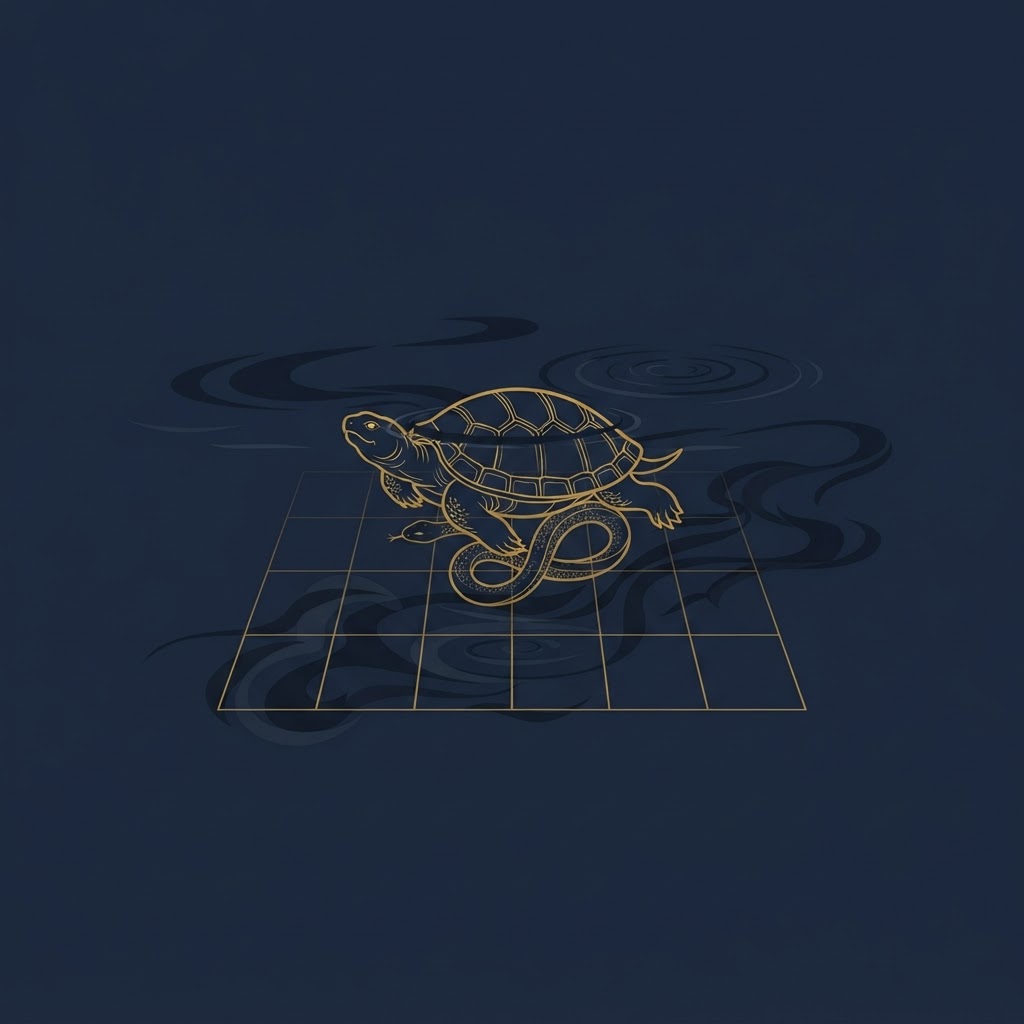
Have you ever analyzed a business transaction where the financial spreadsheets appeared flawless, the executive team projected supreme confidence, and yet capital seemed to evaporate month after month without a clear operational explanation? In my decades of professional practice, dealing with corporate clients across international markets, this exact scenario appears on my desk with alarming frequency. A business owner enters my office holding audited balance sheets, complaining that cash reserves are dwindling despite record sales volume. Another client discovers that a confidential trade secret, developed over three years of private research, was registered by an offshore competitor just two weeks before their official commercial release. When an executive asks me why assets disappear without visible conflict or open legal battles, my eyes immediately scan the nine palaces for one specific force: Xuan Wu (玄武), known in English as Xuan Wu Black Tortoise.
To master Qi Men Dun Jia at a professional level, you must understand that not every threat arrives with a roar. While Bai Hu White Tiger represents open aggression, sudden physical injury, and direct legal assaults, Xuan Wu operates in total silence. It is the deity of Yin Water, subterranean currents, unilluminated dark spaces, hidden motives, information leaks, corporate fraud, quiet pilfering, false claims, and slow structural erosion. In classical Chinese metaphysics, Xuan Wu is named after the legendary Black Tortoise of the northern celestial quadrant, a composite mythical creature depicted as a dark turtle entwined with a serpent. The hard shell of the tortoise represents a solid outward defense, while the winding serpent hidden underneath represents secret movement, infiltration, and undetected maneuvers. When Xuan Wu lands in a palace during a reading, it warns the practitioner that what is displayed on the surface is an illusion designed to distract from what is transpiring beneath.
Throughout ancient military strategy, commanders monitored Xuan Wu to detect enemy spies, poisoned water wells, subverted logistics, and fake troop maneuvers. In our modern commercial environment, the ancient battlefield has transformed into corporate boardrooms, digital cloud servers, intellectual property repositories, and complex supply chain contracts. The cattle thief of the Sung Dynasty has evolved into the cyber infiltrator exfiltrating customer databases, the rogue financial executive manipulating double-entry accounting ledgers, or the strategic partner who quietly files patent applications in an overseas jurisdiction while smiling across the negotiation table. Whether you are conducting financial due diligence, assessing a prospective joint venture, or investigating unexplained inventory shrinkage, learning to read Xuan Wu Black Tortoise provides the forensic clarity required to detect covert risk before it destroys institutional value.
When you sit across from a business owner who is baffled by declining cash reserves, your first responsibility as a Qi Men Dun Jia practitioner is to decouple their emotional confusion from the cold structural reality of the chart. Most business leaders assume that financial loss requires an obvious culprit: a market downturn, a failed advertising campaign, or a publicized legal dispute. They look for large, dramatic events because human psychology is wired to notice noise. Xuan Wu operates precisely in the absence of noise. It takes advantage of operational routines, executive complacency, and trusted interpersonal relationships. By the time an executive realizes that their capital is eroding, Xuan Wu has already established a quiet drainage channel that has been functioning undisturbed for quarters or even years. Understanding the mechanics of this deity allows you to step in as a strategic forensic analyst, helping clients identify structural leaks long before they turn into corporate insolvency.
The Classical Nature of Xuan Wu: The Shadowy Water Deity of the North
In the foundational texts of imperial Chinese metaphysics, Xuan Wu occupies a unique position among the eight deities. While deities such as Zhi Fu Leader command authority and Jiu Tian Nine Heaven drives rapid outward expansion, Xuan Wu belongs natively to Kan Palace 1 in the North, the absolute realm of Water, night, and deep winter. In Five Element theory, Northern Water is cold, fluid, dark, and penetrating. Water does not knock on gates; it flows through invisible cracks, saturates soil from underneath, and erodes rock through persistent, silent pressure. This elemental signature defines the behavioral profile of Xuan Wu Black Tortoise in every hour chart you construct.
Classical Military Lineage: Espionage, Infiltration, and Subterfuge
When imperial military strategists compiled tactical manuals during the Tang and Song dynasties, Xuan Wu was never viewed merely as an abstract sign of bad luck. Military commanders treated Xuan Wu as the operational marker for covert action, night reconnaissance, intelligence gathering, espionage, and psychological warfare. If an advancing army cast an hour chart and found Xuan Wu active in the palace governing their supply lines, the general did not prepare for a frontal clash; he doubled guards around grain stores, checked drinking water sources for contamination, and searched the camp perimeter for enemy infiltrators.
The ancient military texts emphasized that Xuan Wu represents actions conducted away from the light. It governs soldiers who wear black cloaks to cross river beds at midnight, spies who bribe local officials to obtain gate keys, and heralds who spread false rumors inside a besieged city to break enemy morale. Because Xuan Wu embodies subterfuge, it operates through stealth and deception. It does not seek immediate victory through crushing force. Instead, it seeks victory by compromising the opponent's internal integrity, making the adversary vulnerable to sudden collapse when external pressure is applied.
In classical mnemonic texts such as the Yambo Diaosou Ge (烟波钓叟歌), Xuan Wu is repeatedly identified as the emblem of thieves, dishonest servants, and covert spies. The ancient masters noted that when Xuan Wu touches an operational palace, one must examine whether the door is Obstruct Door or Dispute Door, for these reveal whether the thief operates through hidden stealth or vocal extortion. This historical lineage is essential for modern practitioners. When you analyze a business chart containing Xuan Wu, you are looking at the contemporary equivalent of ancient espionage. The operational tactics have modernized, but the underlying Qi remains identical. The deity indicates that one party in the transaction is operating under a dual agenda, keeping critical information hidden in shadow, or actively siphoning value from the collective enterprise.
Military commanders understood that combat efficiency depends entirely on logistics, clear communication, and uncompromised internal trust. When Xuan Wu infiltrated a garrison, it did not attack the commander's tent directly; it subverted the quartermaster, corrupted the scout reports, and loosened the perimeter pins. In corporate consultations today, Xuan Wu functions in precisely the same manner. It targets the procurement manager, the database administrator, the payroll controller, or the quiet co-founder who has access to administrative encryption keys. As a practitioner, your diagnostic lens must look beyond the high-level executive pitch and examine the underlying operational plumbing where Xuan Wu anchors its roots.
Elemental Architecture: Murky Water and Subterranean Flow
The elemental nature of Xuan Wu is Yin Water (癸水 / 阴水), which differs fundamentally from the surging, broad current of Yang Water (壬水). Yang Water behaves like an overflowing river or an ocean tide, visible, powerful, and sweeping everything in its path. Yin Water, by contrast, resembles underground seepage, morning mist, stagnant canal water, or hidden condensation behind walls. It is cool to the touch, difficult to measure, and capable of traveling through tiny porous openings without creating surface sound.
Because Yin Water lacks clarity, Xuan Wu introduces opacity whenever it touches a palace. It obscures vision, blurs contractual language, and creates misdirection. When Xuan Wu resides in a palace alongside a heavenly stem or an eight-door combination, it dampens the bright visibility of that palace. For instance, if an auspicious door like Open Door or View Door lands in the same palace as Xuan Wu, the outward visibility promised by the door becomes tainted by unstated conditions, hidden clauses, or undisclosed liabilities.
Xuan Wu does not break your front gate with an iron ram; it seeps through the foundation until the building tilts and the owner wonders why the doors no longer shut.
This subterranean flow explains why Xuan Wu is intimately connected with slow erosion. When a client suffers financial loss under Xuan Wu, it rarely manifests as a single devastating bankruptcy on day one. Instead, the business loses two percent of its profit margin each quarter to unauthorized vendor kickbacks, five percent of its inventory to employee theft, and ten percent of its customer base to a former manager who quietly downloaded the CRM database before resigning. By the time the business owner notices the damage, the accumulative erosion has compromised the company's financial balance sheet.
Furthermore, Yin Water possesses a unique chemical quality in Five Element theory: it dissolves solids over time. When Water interacts with Earth, it turns solid soil into mud; when it interacts with Metal, it creates rust; when it interacts with Fire, it extinguishes heat. In an hour chart, when Xuan Wu sits in an Earth palace like Palace 2 Southwest or Palace 8 Northeast, it turns solid corporate assets into murky liabilities. When it sits in a Metal palace like Palace 6 Northwest or Palace 7 West, it corrodes corporate governance and executive authority. Recognizing these elemental interactions allows you to pinpoint not only that deception is occurring, but exactly how that deception is altering the physical substance of your client's business.
Modern Forensic Readings: Data Breaches, IP Theft, and Financial Erosion
When clients consult me on high-stakes commercial matters, they rarely ask about classical cattle theft or physical burglaries. In contemporary practice, Xuan Wu manifests across three primary corporate domains: accounting fraud, digital cyber theft, and covert partnership betrayal. As a practitioner, your task is to translate classical water symbolism into actionable business intelligence that protects your client's balance sheet.
Corporate Fraud and Understated Balance Sheet Liabilities
In commercial consultations, Xuan Wu frequently points toward financial misrepresentation. When Xuan Wu combines with Earth stems like Wu or Ji in an hour chart, it signals that financial capital is being misallocated or hidden behind fraudulent entries. A common manifestation is double-entry accounting manipulation, where an executive maintains one set of books for investors and another set for tax authorities. Xuan Wu represents understated liabilities, off-balance-sheet Special Purpose Vehicles (SPVs), or capital expenditures listed as routine operating expenses to artificially inflate net earnings.
When auditing a company before a private equity buyout or corporate merger, the presence of Xuan Wu in the target company's palace demands an immediate deep-dive forensic audit. The deity suggests that revenue figures, while technically matching bank statements, may be inflated through round-tripping transactions or uncollectible accounts receivable that management refuses to write off. The money appears on paper, but like murky water, it vanishes when you attempt to touch it.
Consider a practical scenario involving corporate acquisition due diligence. The seller presents audited financial statements showing five consecutive years of profit growth. However, when you cast the hour chart for the buyer's query, the target company's home palace contains Xuan Wu paired with Wu Earth on the Earth Plate and Ji Earth on the Heaven Plate. In Qi Men Dun Jia, Wu over Ji represents capital buried in mud. This structural signal indicates that while top-line revenue is real, the company is carrying massive unrecorded liabilities, unpaid supplier debts, or pending litigation reserves that have been deliberately omitted from the audit footnotes. Advising your client to inspect off-balance-sheet guarantees immediately uncovers the hidden debt before contracts are finalized.
Digital Piracy, Trade Secret Exfiltration, and Cyber Infiltration
In our hyper-connected economy, intellectual property and digital code constitute the primary assets of modern enterprises. Xuan Wu is the premier deity governing cyber security breaches, unauthorized database scraping, credential theft, and cloud storage exfiltration. Because Yin Water flows through invisible networks, Xuan Wu in a tech company's chart often indicates an active insider threat or a compromised administrative credential.
I frequently observe Xuan Wu active in software launch queries where a key developer or former co-founder has quietly cloned a proprietary repository onto a private server prior to departing the company. The theft occurs without physical disruption; no servers are smashed, and no alarms sound. The code simply exists in two places simultaneously, allowing a competitor to launch a identical application with zero research and development overhead. When Xuan Wu lands alongside stems like Gui or Ren, digital data is actively leaking through unpatched software ports or insecure third-party vendor integrations.
In digital forensics readings, the position of Xuan Wu relative to the nine stars reveals the technical sophistication of the breach. If Xuan Wu is paired with Tian Xin Diplomat Star, the exfiltration is being executed by a sophisticated engineering team using encrypted tunnels and custom scraping scripts. If Xuan Wu is paired with Tian Rui Problem Star, the breach is occurring through an unpatched legacy software vulnerability that IT staff forgot to update. If Xuan Wu aligns with Tian Peng Bandit Star, the enterprise is being targeted by an organized external ransomware syndicate. Matching the deity to the star provides your client's cybersecurity team with the exact vector needed to patch the vulnerability.
Hidden Agendas in Joint Ventures and Strategic Alliances
Joint ventures and commercial partnerships rely on trust and alignment of interest. Yet, when Xuan Wu resides in the palace representing a prospective business partner, true alignment is almost certainly absent. The partner may present an enthusiastic proposal, offer generous terms, and promise access to regional distribution channels. However, Xuan Wu warns that the partner's true motivation is asset extraction, client list poaching, or technology transfer without equitable compensation.
In one memorable consultation involving a cross-border distribution agreement, the hour chart showed Xuan Wu sitting with the prospective partner in Palace 4 Southeast, accompanied by the Obstruct Door and Gui Water. I advised the client that the partner had already established a parallel domestic entity designed to manufacture a local copy of the client's medical devices once the technical schematics were handed over under the guise of regulatory review. Subsequent private investigations confirmed that the partner had already leased factory space for the knockoff production line before the master contract was even signed.
When analyzing partnership queries, pay close attention to the host-guest dynamics between the querent's palace and the partner's palace. If the partner's palace hosts Xuan Wu and generates or controls the querent's palace, the partner possesses the operational leverage to execute their hidden agenda without resistance. If the querent's palace controls the partner's palace, the client can neutralize the threat by imposing strict legal escrow, multi-signature authorization protocols, and mandatory physical inspection rights into the joint venture agreement.
Door Pairings: How Each Door Recolors the Tortoise's Work
A deity never acts alone in a palace, and the door sharing Xuan Wu's ground dictates whether the tortoise works quietly or loudly. When students bring me partnership due-diligence questions, I read the door before the deity, because the door names the arena of action and the tortoise then tells me what hides inside that arena. The same Black Tortoise that signals a silent data leak beside the View Door can signal stolen inventory beside the Open Door, or a fraudulent withdrawal clause beside the Obstruct Door.
| Door Sharing the Palace | Xuan Wu Manifestation | Client Question It Answers |
|---|---|---|
| Open Door | Theft or leakage through public-facing channels; shrinkage at the storefront | Is the leak coming through my public operations? |
| Rest Door | Erosion during downtime; pilfering by insiders while supervision rests | Is the loss happening when nobody is watching? |
| Life Door | Quiet draining of cash flow or health; parasitic partners feeding on growth | Who is feeding off my growth? |
| Injury Door | Fraud that injures directly; deliberate damage disguised as error | Was this accident or sabotage? |
| Obstruct Door | Hidden clauses, withheld documents, deliberate information fog | What is being kept from me in this contract? |
| View Door | Public credibility used as cover; fake metrics, misleading disclosures | Is the visible story a staged display? |
| Death Door | Termination sabotage; asset stripping during a planned exit | Is someone profiting from my ending? |
| Dispute Door | False accusations, forged evidence, litigation built on fabrication | Is the case against me manufactured? |
Notice the pattern across the table: the door names the channel, the tortoise names the concealment. When I teach this pairing logic in class, I ask students to recite it as a two-question habit. What is the arena? What is hiding in it? A practitioner who asks both questions reads depth into every chart, while a practitioner who only says "Black Tortoise means theft" gives clients the accuracy of a horoscope column.
A Mini Reading Walked Through the Pairing Table
To make the table concrete, here is a compact reading I give students as homework. A retail client reports monthly stock shrinkage that annual audits never explain. The hour chart shows Xuan Wu in Palace 1 North with the Open Door, Tian Peng, the Bandit Star, in the neighboring palace feeding it, and the client's Day Stem controlling both grounds from a strong earth palace. Arena: the Open Door names the public sales channel, so the loss moves through the storefront rather than the warehouse. Concealment: the tortoise in its home water palace means the scheme is established and patient. Appetite: the Bandit Star next door means the taker is motivated and organized. Client position: controlling both grounds from strong earth means the client has the standing and tools to cap it quickly. Verdict: organized point-of-sale theft, likely a small ring inside the shift roster, and the client is fully equipped to end it. The verification protocol follows mechanically: cycle counts on high-shrinkage lines, camera review at the till, and shift-pattern analysis. Cases structured like this resolve in weeks precisely because the chart named the channel early.
Stem Companions: Reading the Tortoise Beside the Ten Heavenly Stems
The heavenly stems sharpen the portrait further. Stems describe actors and materials, so a stem beside Xuan Wu usually names the kind of person or instrument through which the hidden action operates. Ji stem, the soft earth of secrets, beside the tortoise suggests a quiet administrative insider, someone with legitimate access and illegitimate intent. Geng stem, hard aggressive metal, suggests coercion or a blunt brute-force attack such as a hostile data exfiltration. Xin stem, the delicate jewel of reform, suggests small precise thefts, micro-withdrawals and shaved margins that individually evade attention.
The pairing logic works in both directions. A stem that produces the tortoise's palace element supplies energy to the hidden activity, which tells me the scheme has momentum and resources behind it. A stem that drains into the palace from outside suggests the scheme feeds on an external party, often the client themselves. In a due-diligence chart for a client examining a proposed joint venture, the position of the Day Stem relative to Xuan Wu's palace becomes decisive: if the client's own stem sits in the palace producing the tortoise's ground, the client is, often unknowingly, funding the very erosion they asked me to detect.
Star Partnerships: Environmental Timing for Hidden Threats
Stars supply the environmental texture, and under Xuan Wu two star families deserve special attention. Tian Ying, the Fearless Star, with its heat and brilliance, exposes what the tortoise hides, so Xuan Wu meeting the Fearless Star in a strong palace means the hidden activity will surface quickly; my advice shifts from prevention to rapid response and evidence preservation. Tian Zhu, the Destroyer Star, cutting and exposing, works the same way with harder edges: the fraud gets cut open, often loudly, and the client should prepare for a public rupture rather than a quiet cleanup.
Opposite families deepen the concealment. Tian Peng, the Bandit Star, beside Xuan Wu is the classic theft signature in classical texts, appetite meeting opportunity, and I read it as active, motivated pilfering rather than passive leakage. Tian Rui, the Problem Star, slows the erosion into a chronic condition, the kind of long-term quiet drain that appears in the client's numbers as a mystery cost creep over years. When neither exposing star nor concealing star shares the ground, the tortoise's work stays neutral, and the ordinary palace mechanics carry the verdict.
Three Shadows Compared: Black Tortoise, Darkness, and Serpent
Beginners blur Xuan Wu with Tai Yin, Darkness, and with Teng She, the Serpent, because all three carry shadowy reputations. The three must be kept apart with surgical clarity, because each shadow asks a different question of the chart. Xuan Wu is the shadow that takes: theft, fraud, false claims, hidden motives. Darkness is the shadow that shelters: quiet support, unseen help, protective concealment. The Serpent is the shadow that twists: anxiety, winding paths, shifting intentions, strange turns of mind. One robs, one shields, one coils through the client's imagination and circumstances.
| Shadow Deity | Core Function | Honest Client Question | Diagnostic Habit |
|---|---|---|---|
| Xuan Wu, Black Tortoise | Takes and erodes | Who is taking from me, and how? | Audit flows: money, data, inventory, clauses |
| Tai Yin, Darkness | Shelters and supports | Who is helping me unseen? | Look for quiet allies and unpublished goodwill |
| Teng She, Serpent | Twists and worries | Is the danger real, or is my fear doing the coiling? | Separate evidence from anxiety before advising |
I drill this comparison because the practical consequences diverge completely. A client under a strong Xuan Wu needs audits, controls and verification. A client under a strong Tai Yin needs to be told their quiet supporters exist and should not be exposed carelessly. A client under a strong Serpent needs to be told their worry is doing most of the work, and that no investigation should be launched until evidence separates fear from fact. Misname the shadow and you prescribe the wrong medicine every time.
Readers who want the full mechanics of the other two shadows can study my deep dives on Teng She, the Serpent Deity and Tai Yin, the Darkness Deity, and the parent overview of the eight deities of Qi Men Dun Jia places the whole layer in context.
A final word on teaching this deity, because Xuan Wu is where new practitioners either gain their professional footing or slide into paranoia. In my classes I ask students to bring one chart where the tortoise appears and to argue the strongest possible innocent reading before arguing the guilty one. The discipline of building both verdicts prevents the single worst habit in deity work, which is using the classical reputation as a shortcut around analysis. Every deity in the layer, including this one, is weather. Weather is neither moral nor immoral; it is a condition you dress for, plan for, and occasionally exploit.
Worked Chart One: Catching the Hidden Deceiver in a Partnership
A manufacturing client asked me in February 2026 to review a proposed partnership with a regional distributor. The paperwork was polished, the distributor's references checked out, and my client liked the founder personally, which is precisely the combination that deserves a chart before a signature. I cast the hour chart for the moment my client asked the question, using local solar time at his facility.
The four pillars of the moment were Bing Xu day, Ji Chou hour, inside a Yang Dun period. The chart arrived as Ju 3, placing the hour stem arrangement across the palaces in forward rotation. The distributor's significator, the Hour Stem of the query, landed in Palace 1 North, the water palace, alongside Xuan Wu. The Black Tortoise sat directly with the party being investigated, in its own murky element, and the palace was further weakened by Emptiness on the day branch, hollowing the ground beneath the distributor's position. On the door layer, the Obstruct Door shared the palace, a textbook signature of withheld information sitting inside the partnership's foundation. On the star layer, Tian Peng, the Bandit Star, the classical star of appetite and theft, rotated into the same palace.
Every layer told one consistent story. The party across the table had concealed material information, had appetite for what did not belong to them, and stood on ground that could not bear long-term weight. My client's Day Stem, Bing, sat in Palace 4 Southeast inside strong seasonal wood, healthy and well-resourced but producing the palace of the tortoise, meaning my client's own strength was actively feeding the counterparty's scheme: his capital, his inventory and his market access were exactly what the hidden party intended to draw upon.
My verdict was direct. Do not sign in the current structure. If the commercial logic still justified the deal, demand three verifications first: independent audit of the distributor's receivables, escrow of initial inventory shipments, and named guarantors behind the payment terms. I also told my client to expect one specific discovery: a side agreement between the distributor and a competing supplier, because the Obstruct Door hiding in the counterparty's palace almost always hides a document.
The verification process took eleven days. The receivables audit found a 31 percent overstatement of the distributor's monthly order book, and the side agreement existed precisely: an exclusivity arrangement with a competitor covering the very product category my client intended to lead with. My client walked away, redirected the marketing budget to a second distributor candidate examined under a later and much cleaner chart, and later told me the eleven days of verification had cost less than one month of the losses the original deal would have produced.
Worked Chart Two: Protecting Intellectual Property Before a Launch
The second case concerned a software company preparing to demonstrate a proprietary algorithm at a regional trade show in May 2026. The founder, a former student of mine, asked a narrower question: given that we must demo publicly, which hours this month leak the least? This is date selection under Xuan Wu logic, and the framing matters, because the question was not whether to launch but how to launch with controlled exposure.
I charted the company's demo day candidates and compared them. The first candidate hour, a Geng Zi hour on a Wu Chen day, placed Xuan Wu in Palace 9 South together with the View Door, the palace of public display. Tortoise inside public visibility meant the leak risk was not theoretical; demonstration screens, marketing collateral and network activity would all sit in the open. Worse, Tian Zhu, the Destroyer Star, sat in the controlling palace, ready to cut the concealment open loudly.
The second candidate, a Ji Wei hour on a Gui Chou day eleven days later, told a different story. Xuan Wu rotated into Palace 2 Southwest, an earth palace that controls water, literally capping the tortoise's element. The Fearless Star, Tian Ying, occupied the palace producing the company's significator, and the door layer carried the Rest Door, favoring deliberate, contained action. The demo would still be public, but the structural weather no longer fed leakage; it contained it.
My advice followed the structure. Use the second window. Before the demo, file the provisional patent, watermark every slide, pre-load the algorithm with a remote kill switch for the demonstration build, and limit live data to dummy datasets. The founder executed every item. The trade show demo succeeded, and three months later the company discovered a former booth visitor had attempted to file a suspiciously similar provisional claim; the earlier filing date gave the company clean priority. The tortoise had been in the room either way, but the chart chose the hour in which it stayed in its shell.
You cannot remove the tortoise from the water. You can choose the hour in which the water is too shallow for it to swim.
Both worked charts share one teaching point. In each case the chart did not replace diligence, security procedure or legal protection; it directed the client's protective effort to the exact place and hour where the structure was weakest. That is what deity analysis is for in professional practice.
Follow-Through: What the Two Windows Cost and Saved
For the record I keep of every published case outcome, the two candidate windows in the software demo matter for their asymmetry. The rejected first window would have placed the demonstration inside leak-favorable weather, and the patent filing would have followed the trade show instead of preceding it, surrendering priority to any attendee who moved fast. The chosen second window reversed the order at almost no cost: eleven calendar days of preparation, one provisional filing fee, and one internal security memo. The difference between the two futures was not luck. It was sequence: protect first, display second, in a window whose structure capped the tortoise. Students who reduce date selection to superstition should price that asymmetry first.
The Security Playbook: What I Advise Clients Under the Tortoise
When a consultation surfaces a strong Xuan Wu, my written advice always pairs the chart reading with a practical control list, because a warning without a protocol only manufactures anxiety. The list below is the distilled version I have refined across corporate cases. It is deliberately unglamorous. Fraud prevention usually is.
For financial exposure: dual authorization on all payments above a set threshold, monthly reconciliation of every account by someone other than the person who initiates transactions, and mandatory annual rotation of financial duties so no single employee owns a process end to end. For information exposure: access logs on the document repository, classification of sensitive files, and a clean desk policy enforced before any partner meeting. For contractual exposure: every material clause read aloud in the final review meeting, no signature under time pressure, and an insistence that amendments take written form even when goodwill is high. For personnel exposure: reference checks that actually call people, and a habit of noticing when one employee resists the rotation of duties.
| Leakage Channel | Baseline Control | Chart Trigger |
|---|---|---|
| Payments and withdrawals | Dual authorization, monthly third-party reconciliation | Xuan Wu with Ji or Xin stem on the client's money palace |
| Documents and data | Access logs, file classification, clean desk policy | Xuan Wu with Obstruct Door or Emptiness in the document palace |
| Contracts and clauses | Read-aloud review, no time-pressure signing, written amendments | Xuan Wu in the partnership or negotiation palace |
| Inventory and assets | Cycle counts, camera coverage, receiving sign-offs | Xuan Wu with Tian Peng, the Bandit Star, on the asset palace |
| Personnel and access | Reference checks, duty rotation, alertness to control resistance | Xuan Wu producing or feeding on the querent's Day Stem palace |
One instruction I give every client under a strong tortoise reading is to resist the reflex of public accusation. The chart shows structure, not identity, and naming a suspect before evidence exists burns trust and invites legal exposure. Investigate quietly, document thoroughly, and let the verification process name the party. In my experience the deceptive party under a Xuan Wu chart almost always reveals themselves through a verification step they cannot pass, which is a far stronger position than any accusation.
The Legal and Insurance Layer That Completes the Playbook
Two protections sit outside the chart and the control list, and I insist on both for business clients. First, indemnification and fidelity clauses: every partnership contract I review under a tortoise-influenced chart gets an express indemnity for concealed liabilities and a fidelity carve-out that survives assignment. Second, appropriate insurance: fidelity crime coverage for internal theft, cyber coverage for the data channel, and errors and omissions coverage for the professional channel. The chart tells you which channel the weather favors this season, and the insurance map tells you which channel bleeds cash if the warning was right. A client who buys all three coverages blanket-wide pays for protection they do not need; a client guided by the palace reading buys the right one and sleeps.
Practitioners who advise corporate clients should also learn to write the limitation sentence of every tortoise reading: that the chart directs verification and cannot itself identify individuals or substitute for forensic evidence. It is the sentence that keeps the reading inside its honest competence, and it costs you nothing except the temptation to look more mystical than the system actually claims.
The Honest Limit of the Checklist
For balance, the checklist has a failure mode I must name. Controls tighten, verification passes, and the client concludes the warning was empty. Sometimes it was: a dormant tortoise on weak ground is a shadow with no scheme behind it, and calm readings accept that outcome without embarrassment. The purpose of the reading was never to guarantee that fraud existed; it was to ensure that if a scheme was in motion, it met locked doors instead of open ones. I record the clean outcomes in the same file as the caught ones, because a practitioner's track record on this deity is measured by verification quality, not by drama quota. Clients deserve a reader who is equally comfortable saying the coast is clear.
Six Pitfalls When Reading Xuan Wu
First, calling every tortoise appearance a thief. Xuan Wu in a dormant, unsupported palace often indicates only that a client's suspicion exists, not that a fraud does. Second, ignoring the querent's own contribution, which I emphasized above: a Day Stem feeding the tortoise's palace means the client is funding their own leakage. Third, treating the tortoise as always evil, when classical generals used Xuan Wu hours deliberately for counter-intelligence, for concealment of troop movements and for quiet exits that needed exactly this weather.
Fourth, reading the deity without its palace grade. A tortoise on exhausted, clashed ground is a petty pilferer; the same tortoise on strong, supported ground is an organized operation, and the response plans differ accordingly. Fifth, forgetting the season, because water is strongest in winter, and a winter Xuan Wu reading carries more weight than the identical summer configuration. Sixth, doom-telling to the client. The practitioner's job under this deity is calibrated vigilance, and a client who leaves the reading too frightened to operate has been served poorly, whatever the chart said.
Two Snapshots From My Case Notebook
Two smaller snapshots complete the picture of how this deity reads in the wild. In one, a logistics client asked about a single missing container, and the hour chart placed Xuan Wu with Tian Peng, the Bandit Star, in the client's asset palace on a strong autumn metal ground. The container was never found; the investigation traced it to an organized group that had been shaving one container per quarter, which is exactly what a strong, well-fed, patient tortoise describes. In the other, a family asked about a missing heirloom ring, and the same deity sat in an emptied palace beside Tian Zhu, the Destroyer Star. The ring surfaced within the week, cut open from its hiding place by a renovation nobody had scheduled. Same deity, opposite grades, two entirely different verifications: one warranted an audit of quarterly patterns, the other warranted waiting for the structure to cut itself open.
Palace Mechanics: Where the Tortoise Is Strongest and Where It Drowns
Because Xuan Wu belongs to water in its murky northern aspect, its operational strength varies sharply across the nine palaces. In Palace 1 North, its own deep water home, the tortoise is at full strength: concealment is total, erosion is slow and invisible, and discovering anything requires deliberate verification work. In Palace 6 Northwest, hard metal ground generates water and feeds the tortoise's work, so hidden actions gain structure and continuity, the signature of organized, patient schemes rather than opportunistic theft. In Palaces 2, 5 and 8, the earth palaces control water, capping the tortoise, which is why the IP case above improved so dramatically when Xuan Wu rotated into Palace 2: the ground itself restrained the leak.
The wood palaces, 3 and 4, drain the tortoise by feeding on it, meaning hidden schemes in those palaces consume themselves and surface through their own excess; my monitoring advice there is shorter because exposure tends to arrive on its own. Palace 9 South is the tortoise's most uncomfortable seat, fire boiling water, and secrets placed there survive only briefly, though the boiling is loud and the client should expect a rupture rather than a quiet cleanup. Season overlays all of this: winter strengthens every water configuration, summer weakens it, and the earth months of the transitional seasons quietly cap it.
For students who want the full palace mechanics behind this layering, my article on the Nine Palaces of Qi Men Dun Jia works through the Lo Shu grid element by element, and my guide to how a chart is constructed shows exactly how the deity layer rotates into place each hour.
Alliance Red Flags the Tortoise Palace Names in Advance
In alliance due-diligence work, four red flags from the joint-venture literature correspond so cleanly to palace configurations that I keep them on one card. First, the partner who insists on controlling the audit function: the Black Tortoise's palace sitting on the shared-governance significator. Second, the partner whose contributions are valued by their own appraisers: Xuan Wu fed by the partner's stem. Third, the joint venture whose reporting deadlines always land after decisions become irreversible: the Obstruct Door sharing the tortoise's ground. Fourth, the partner who resists written amendment of anything agreed verbally: the tortoise in a strong winter palace, in no hurry to surface. I hand the card to client lawyers along with the chart, because the two languages together are more persuasive than either alone.
The honest caveat belongs here too. Alliances sometimes fail through ordinary misalignment rather than deception, and not every negotiation delay is a tortoise at work. The deity names the weather of concealment, so it earns attention, not automatic conviction. My written verdicts in alliance work always end with the same sentence I give students: verify, then judge.
A One-Page Client Brief Format That Works
Corporate clients rarely want classical commentary; they want a brief they can forward to their auditor. The format I use fills one page. Header: query, date, and the operational question in plain language. Section one: findings, three lines stating the palace grade, the concealment type and the channel at risk. Section two: verification protocol, numbered, matched to the channel, each item executable within a fortnight. Section three: follow-up, the next checkpoint date and what will be re-read then. Footer: the limitation sentence, stating that the analysis directs verification and does not identify individuals. The page takes twenty minutes to compose from a full chart analysis, and it has survived more than one legal review, which is the standard that matters for professional practice.
The Six-Step Tortoise Protocol in Professional Consultations
Deity readings collapse into vague warnings unless the practitioner works a fixed sequence. My tortoise protocol has six steps, and I teach it as the minimum standard for any fraud-adjacent query.
- Frame the question with the client in operational language first: what asset is at risk, and through which channel does it move? A chart cast against a vague question produces vague weather.
- Cast for the moment of the question, locate Xuan Wu, and grade its palace by element, season and afflictions exactly as laid out earlier in this article. Write the grade before interpreting anything else.
- Identify the significators: the client's Day Stem, the counterparty's representation, and the channel through which the asset moves. Position each against the tortoise's palace and record the five-element relationship.
- Read the whole palace voice, door, stem, star and deity together, in one sentence, naming the specific kind of concealment active in this matter.
- Translate the finding into a verification protocol matched to the channel: financial audit for money palaces, access-log review for document palaces, cycle counts for inventory palaces, provenance demands for litigation palaces.
- Schedule a follow-up chart at the client's next decision checkpoint, because erosion structures evolve and a single reading is weather, not climate.
The protocol earns its keep in the follow-up step more than anywhere else. Erosion structures shift with the seasons and with the client's own countermeasures, and the second chart frequently shows the tortoise migrating palaces once controls tighten. Reading that migration tells you whether your countermeasures bit, and it gives the client a rare measurable result from divination: the structure of concealment visibly weakened after the audit went in.
The Six-Step Tortoise Protocol as a Picture
For students who retain diagrams better than lists, the protocol compresses into the flow below. Its value is the same as the written version: it refuses to let the practitioner skip the feed question, which sits at the exact center of the flow, and it ends in a verification protocol rather than in an accusation, which is where every professional tortoise reading must end.
I keep this version on the last page of my workshop handouts, and students report pinning it beside their desks more often than the written protocol. Whatever form carries the discipline, the discipline itself is the product: a tortoise reading that ends in scheduled verification is professional work, and everything else is commentary.
One habit completes the picture version: the diagram is drawn, not memorized, during the consultation. Practitioners who sketch the six steps live, checking each against the chart as they go, produce readings whose logic the client can audit in real time, and auditable logic is what separates professional metaphysics from performance. The client may never read a palace, but they can always follow an arrow, and a client who follows the arrows remembers the reading as advice rather than as theater.
For teams, the diagram has one more office use worth mentioning: it converts a tortoise reading into a briefing tool. Security and finance managers who cannot read a palace can read step five, and step five tells them exactly what to do on Monday morning. In my corporate work, the diagram has done more for client follow-through than any amount of classical explanation, because it moves the reading out of the consultation room and into the task list where protection actually happens.
Follow-through, measured in tasks completed rather than meetings attended, is the only honest metric for security consulting under this deity, and the diagram exists to raise it.
That metric, task completion at the one-month check, is what I now report back to boards when they ask what the reading achieved.
Boards understand metrics, and metrics are how the classical system earns its permanent seat at the modern table.
Practitioner FAQ: Nine Questions on the Black Tortoise
Does Xuan Wu always mean someone is stealing from me?
No. It means the structure of the moment favors concealment and quiet taking, and the three honest readings are active theft, passive leakage, or your own suspicion looking for somewhere to land. The palace grade, the accompanying door, stem and star, and the querent's Day Stem relationship separate those three. I refuse to issue any accusation verdict without the full five-layer read, and even then my written advice points to verification steps, never to names.
Can the tortoise ever be favorable?
Frequently, when you need concealment yourself. Classical strategists used Xuan Wu hours to move troops unseen, and modern uses include confidential filings before a public launch, quiet negotiations that must not leak, personal matters requiring discretion, and competitive research. The deity describes the weather of hiding; who benefits depends on whose agenda the hiding serves.
How is Xuan Wu different from Bai Hu in a fraud question?
Bai Hu, the White Tiger, governs open force, pressure and hard contact; fraud under White Tiger arrives as coercion, aggressive demands or visible intimidation. Xuan Wu works the opposite way, never showing a claw. If losses come with threatening phone calls, look to the tiger; if losses come with perfect smiles and spotless paperwork, look to the tortoise. My deep dive on Bai Hu, the White Tiger Deity covers that forceful territory in full.
What does Xuan Wu in an emptied palace mean?
The concealment lacks a functioning foundation. Practically this reads as attempted deception that fails or dissolves: the hidden party lacks the resources, discipline or internal cover to sustain the scheme, and discovery tends to arrive early. It is a far lighter reading than the same deity on strong ground, and over-warning the client is the common error.
How do I read Xuan Wu against my own Day Stem?
Three positions matter. Your stem producing the tortoise's palace means you are feeding the leakage, usually through over-trust or missing controls. Your stem controlling the tortoise's palace is the strongest position: you have the standing and the tools to cap the scheme, so act on it. The tortoise's palace producing your stem is the confusing one, where the hidden party appears generous, and generosity received from a tortoise palace deserves a verification step before it is banked.
Should I warn business clients openly about Xuan Wu findings?
Present findings as verification recommendations, not accusations. Say: the structure of this window favors hidden information, so before signing, complete these three checks. Clients accept that framing readily, and it keeps you away from defamation territory. The chart directs attention; evidence convicts.
Does the tortoise's strength change with the seasons?
Yes, and the effect is one of the easiest to verify in your own case archive. Winter water months deepen Xuan Wu readings, and fraud cases cast in winter tend to run longer before discovery. Summer fire months boil the tortoise's work into exposure, and my summer partnership charts surface hidden clauses faster than any other season. Grade every tortoise reading with the seasonal layer or the verdict will drift.
How does Xuan Wu interact with the Dispute Door?
It is the signature of manufactured conflict: forged evidence, false claims, litigation built on fabrication. When this pairing appears in a legal question, my advice to the client is to demand documentary provenance for every claim the opposition files, because the chart says the paper trail itself is the battlefield. My article on the Dispute Door gives the door's full mechanics for litigation work.
What single habit best protects clients under Xuan Wu?
Separation of duties. Nearly every serious fraud I have seen in professional practice relied on one person owning a process end to end. The chart can point to the palace and the hour; the internal control of who may act alone is the human lock that the tortoise finds hardest to pick.
Closing the Case: Honest Vigilance Without Paranoia
Xuan Wu teaches the least comfortable lesson in the deity layer: the world contains quiet taking, and competence means facing that fact with procedure rather than with fear. A client who leaves a tortoise reading with a verification checklist is empowered; a client who leaves with vague dread is disarmed. I train practitioners to deliver the first outcome every time, because the chart names the weather of concealment, and human diligence still builds the roof.
If you want to build this competence systematically, start with my complete guide to what Qi Men Dun Jia is, then study the deity layer through the parent overview of the eight deities, and work outward through the doors, stars and palaces until the five layers read as one sentence. The tortoise rewards those who check, and it punishes those who assume. That is the whole of it.
The Tortoise and the Snake Wrapped as One Beast
Students often ask why the deity is sometimes drawn as a tortoise and sometimes as a snake coiled around it. The classical answer is structural, not decorative. The tortoise is the shell, the durable, slow-moving body of concealment; the snake is the head, the quick, striking instrument of deception. Together they describe exactly how the deity operates in a chart: long, patient, armored concealment that ends in a single fast strike when the moment arrives. When I see Xuan Wu strong and well-supported in a chart, I am looking at the shell phase, the quiet accumulation. When the palace also carries a fast, aggressive stem like Geng or a volatile star like Tian Chong, the snake head is out, and the client should expect the strike soon rather than eventually.
The composite animal also explains the deity's association with water in its murkiest aspect. A tortoise moves through deep water invisibly, feeling its way, appearing only when it chooses to surface. Classical texts extended the image to the northern sky, where the celestial tortoise-snake guards the water quadrant. This is why the modern reading of Xuan Wu always begins with a simple question borrowed from the image itself: what is moving beneath the surface here, and when does it intend to come up for air?
How the Deity's Reputation Shifted Across Dynasties
The tortoise's job description changed as Chinese governance changed. In the early military corpus, Xuan Wu was primarily a counter-intelligence officer: the deity that governed scouts, infiltrators, false deserters and the movement of information under siege. By the Tang and Song periods, as the system migrated from the battlefield into civilian divination, the same concealment weather was reapplied to the quieter crimes of civil life, and the deity settled into its modern reputation for theft, fraud and false claims. The Ming and Qing practitioners added the psychological layer, using Xuan Wu to read hidden motives in domestic and commercial disputes. Nothing about the deity changed; the arenas that needed concealment did. That history is worth teaching, because it reminds students that Qi Men Dun Jia is a living analytical system that follows human activity rather than a frozen museum of omens.
Reading Erosion in the Numbers: A Practitioner's Checklist
Before any client meeting, I ask for the last twelve months of the operation's key numbers, because the tortoise announces itself in financial patterns long before anyone confesses. The checklist I use is short enough to memorize. Gross margin drift without an operational explanation. Receivables aging faster than sales growth. Inventory counts that pass annual audits but fail surprise cycle counts. One vendor whose pricing never gets benchmarked. One employee who never takes leave. Payments to unfamiliar entities that clear just below authorization thresholds. Any two of these together deserve a tortoise-grade verification pass even if no chart has been cast.
What the chart adds to this checklist is timing and direction. The numbers tell you that erosion is happening; the palace placement tells you which channel it flows through, and the seasonal grade tells you whether it will surface this quarter or stay buried for a year. In client presentations I show the checklist first and the chart second, in that order, because business owners trust a system that speaks their financial language before it speaks the classical one.
The Modern Cyber Reading, Translated From the Classical Vocabulary
Cybersecurity teams and classical practitioners describe the same animal in different languages, and translating between them has become one of my regular consulting services. Reconnaissance is the shell phase, the quiet underwater movement before any strike appears. Data exfiltration is the feeding phase, assets leaving in small transfers sized to evade threshold monitoring. The final use of stolen credentials is the snake-head strike, fast and after long patience. When a security team brings me a chart alongside their incident timeline, the correspondence is usually uncomfortable for everyone in the room: the palace that hosted Xuan Wu on the breach date is, in most post-incident reviews, exactly the subsystem where the intrusion lived quietly for months.
For clients building preventive calendars, the useful application is softer but still concrete. I chart the deployment windows for sensitive system changes and avoid scheduling major migrations into hours where Xuan Wu sits strong in the relevant palace, not because the hour itself can block a hacker, but because error rates, misconfigurations and missed alerts all rise in exactly the weather where hidden information thrives. Security engineers accept the advice surprisingly fast once they map it onto their own incident statistics.
Why the North Owns the Shadow
The assignment of Xuan Wu to the northern quadrant is astronomy before it is symbolism. In the classical Chinese sky, the northern dipper of stars named Xuan Wu occupies the water quadrant, and the whole calendrical machinery of the system, including the rotation that governs deity placement, is anchored to that northern reference. The north is also the direction of deep winter, of midnight, of the hour of stillness before dawn, which is why every northern reading carries a season of concealment inside it. When students ask why the tortoise could not simply have been assigned the east or the south, I point them to the sky rather than to a philosophical argument: the system's founders drew the deity from a star group that the entire civilization already associated with water, darkness and the unseen half of the year.
Practically, this astronomical root means that northern placements of Xuan Wu in a chart are home-ground placements, the deity at full native weight, while placements in the fire quadrant are fish out of water, struggling to keep any concealment alive. I grade the nine palaces accordingly, and the diagram later in this article shows the full strength map that follows from this single astronomical fact.
One closing instruction for practitioners: end every tortoise reading with a calm sentence. My standard line, delivered slowly, is that the chart has shown us where to look, the checklist has shown us how to look, and the client's own diligence will decide what we find. Fraud fears metastasize in silence, and the practitioner's final job under this deity is to return the client to operational confidence with structure in hand. A calm sentence costs nothing and saves the working relationship.
The Embezzlement Profile the Tortoise Keeps Repeating
Across the corporate cases in my files, the internal embezzlement signature repeats with uncomfortable regularity, on the chart and off it. Off the chart, the profile is famous from forensic literature: the trusted veteran, spotless reputation, allergic to vacation, personally protective of a single process. On the chart, the matching signature is equally regular: Xuan Wu strong in the palace governing the client's financial significator, Ji or Xin stem quietly seated alongside, and an earth palace providing patient cover. The deity describes a long slow drain, and the drain needs exactly the kind of armored concealment an earth palace provides.
The instructive failure is what clients do with the warning. The chart says verify the process, the owner hears accuse the veteran, and the consultation tips into drama that serves nobody. I now refuse to deliver internal-fraud readings in person until the client has a third-party audit scheduled, because the chart's proper function is to make the audit happen calmly, not to appoint a suspect. In more than one case the audit cleared the veteran and found the loss was a vendor scheme two layers out, which the palace logic also supported once the significators were read correctly. Verification before accusation is not merely ethics; it is accuracy.
Counter-Intelligence: When the Commander Wanted the Tortoise
The classical manuals did not treat Xuan Wu as an enemy to be avoided at all costs, and neither should the modern reader. A commander planning a night withdrawal needed concealment weather, and the texts name tortoise-influenced hours as the preferred windows for moving troops out of contact, planting false campfires, and letting deserters carry fabricated plans to the opposing camp. In one frequently cited campaign episode, a general deliberately released a captured officer during a strong tortoise window, knowing the officer would carry back the inflated troop numbers his staff had planted. The deception held precisely because the weather of the hour favored hidden information crossing lines. Read that episode as a practitioner and the lesson generalizes instantly: the deity describes the concealment channel, and the strategist decides whose information travels through it.
Modern equivalents sit closer than students expect. A company briefing analysts before a public announcement is planting its own campfires. A founder meeting investors under a non-disclosure umbrella is moving troops out of contact. The chart's tortoise window is neutral infrastructure, and the skill professional practitioners sell is knowing when the client should avoid that weather and when the client should hire it.